
A Cognitive Stress Test for the Brain: Understanding the Montreal Cognitive Assessment (MoCA)
How the Montreal Cognitive Assessment Reveals Hidden Cognitive and Neurological Dysfunction

By Dr. David Traster, DC, MS, DACNB
Co-owner, The Neurologic Wellness Institute
Boca Raton • Chicago • Waukesha • Wood Dale
www.neurologicwellnessinstitute.com
Imagine walking into a neurologist’s office and being handed a piece of paper. The clinician asks you to draw a clock, remember a few words, connect some letters and numbers, name a few animals, and repeat a sentence.
It seems almost too simple. How could a test that takes less than fifteen minutes possibly reveal meaningful information about one of the most complex structures in the known universe? Yet that is exactly what the Montreal Cognitive Assessment (MoCA) was designed to do.
For clinicians who work with concussion, dementia, stroke, Parkinson’s disease, multiple sclerosis, vestibular disorders, long COVID, and countless other neurological conditions, the MoCA often serves as a quick window into the functional health of the brain. It does not diagnose a disease by itself. Rather, it helps identify patterns—small clues that tell a larger story about how different brain networks are functioning.
Like a detective collecting evidence from multiple witnesses, the MoCA gathers information from different cognitive systems and helps us understand where the brain may be struggling.
The Birth of the MoCA
The Montreal Cognitive Assessment was developed in 2005 by neurologist Ziad Nasreddine and colleagues in Montreal, Canada.
At the time, clinicians were relying heavily on the Mini-Mental State Examination (MMSE) to screen for cognitive impairment. While useful, the MMSE often missed subtle cognitive deficits, particularly in highly educated individuals or patients with mild cognitive impairment.
The MoCA was designed to be more sensitive. Instead of focusing primarily on memory and orientation, it challenged multiple brain systems simultaneously, making it far better at detecting early neurological dysfunction.
Today it is one of the most widely used cognitive screening tools in neurology, geriatrics, rehabilitation medicine, neuropsychology, and concussion care.
Why Cognitive Testing Matters
Many neurological disorders begin long before obvious symptoms appear.
A person may complain of brain fog. Another may struggle to find words during conversations. Someone recovering from a concussion may notice that multitasking feels exhausting. A patient with vestibular dysfunction may feel mentally slower despite normal MRI findings.
The brain can often compensate for dysfunction for months or years before major symptoms emerge. Cognitive testing allows clinicians to measure performance rather than relying solely on subjective complaints.
The MoCA helps answer an important question:
How well are the brain’s networks communicating with one another?
Executive Function: The Brain’s Chief Executive Officer
One of the first tasks in the MoCA involves connecting alternating numbers and letters.
1-A-2-B-3-C.
Simple on the surface. Neurologically, however, this task is remarkably demanding. The brain must maintain attention, inhibit errors, switch between mental rules, and monitor performance simultaneously.
These abilities depend heavily upon the prefrontal cortex, particularly the dorsolateral prefrontal cortex. This region acts like an executive director overseeing countless mental operations.
The task also recruits the anterior cingulate cortex, which monitors conflicts and errors, and large-scale frontoparietal networks that coordinate attention and working memory.
Difficulty with this section may be seen in:
Concussion
ADHD
Parkinson’s disease
Frontal lobe injuries
Long COVID
Multiple sclerosis
Neurodegenerative disorders
Clinically, deficits here often appear before memory problems become obvious.
Drawing the Cube: Visual-Spatial Construction
Next comes a seemingly innocent challenge.
Copy a cube.
Many patients assume this measures artistic ability. It does not. The cube tests visual-spatial processing and constructional ability. To perform the task successfully, the brain must accurately interpret three-dimensional relationships and translate them into coordinated motor output.
This depends heavily on the posterior parietal cortex, particularly the right hemisphere, along with occipital visual processing networks and premotor planning regions.
When patients struggle with this task, clinicians begin considering dysfunction involving parietal networks, visuospatial processing, stroke, neurodegenerative disease, or certain forms of dementia.
The inability to accurately perceive spatial relationships can profoundly affect daily life, from driving a car to navigating a crowded grocery store.
The Clock Drawing Test: A Symphony of Brain Networks
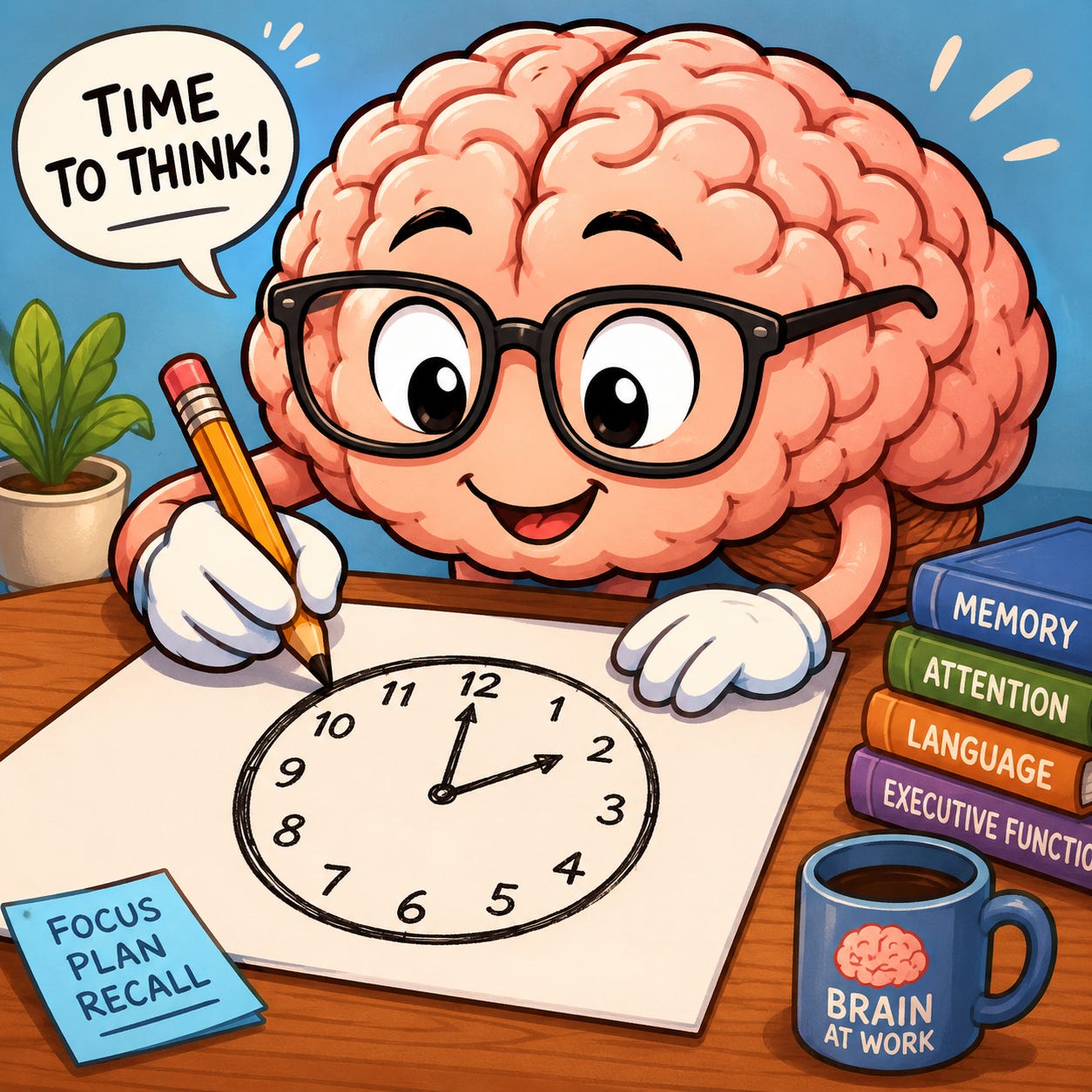
Few tasks in neurology provide as much information as drawing a clock.
Patients must draw a circle, place numbers correctly, and position the hands at a specific time. What appears simple actually requires extraordinary coordination between multiple systems. Visual-spatial processing. Motor planning. Attention. Working memory. Executive function. Error monitoring.
The clock-drawing task engages:
Frontal lobes
Parietal lobes
Basal ganglia
Cerebellum
Visual association cortices
The clock test is so valuable because it reflects integrated brain function. It is less about one region and more about communication between regions. Like an orchestra, the performance depends not only on the musicians but also on how well they play together.
Naming Animals: Language Networks at Work
The MoCA asks patients to identify several animals.
Although straightforward, this task probes semantic memory—the brain’s library of stored knowledge. Successful performance relies heavily upon the temporal lobes, particularly the dominant temporal cortex and temporal pole.
Language regions including:
Wernicke’s area
Inferior temporal cortex
Semantic association networks
must work together to retrieve the correct word.
Difficulty naming common objects or animals may indicate problems involving language networks, temporal lobe dysfunction, or neurodegenerative conditions affecting semantic memory.
Memory: The Hippocampus Takes Center Stage
One of the most recognizable portions of the MoCA involves remembering a short list of words.
The words are presented, repeated, and then recalled later. This task primarily evaluates episodic memory. The star of this process is the hippocampus. Located deep within the temporal lobe, the hippocampus acts as a memory indexing system, helping convert experiences into long-term memories. However, memory is never the job of a single structure.
Successful recall requires cooperation among:
Hippocampus
Entorhinal cortex
Prefrontal cortex
Thalamus
Default mode network
Early hippocampal dysfunction is one reason memory impairment often appears in disorders such as Alzheimer’s disease. When patients struggle with delayed recall, clinicians immediately begin thinking about the health of these memory circuits.
Attention: Holding Information Online
The attention section challenges patients to repeat numbers, identify target sounds, and perform mental calculations. These tasks recruit working memory systems centered within the dorsolateral prefrontal cortex.
Additional involvement comes from:
Parietal attention networks
Anterior cingulate cortex
Thalamic circuits
Basal ganglia loops
Attention is the gateway to cognition. Without attention, memory formation becomes impaired. Learning becomes difficult. Executive function deteriorates. This is why patients with concussion, vestibular disorders, chronic pain, sleep deprivation, anxiety, and dysautonomia frequently score lower on these tasks despite having structurally normal brains.
Language and Sentence Repetition
The MoCA includes sentence repetition and verbal fluency tasks. These assess expressive language and language production.
Key regions include:
Broca’s area
Supplementary motor area
Inferior frontal gyrus
Arcuate fasciculus
Temporal language regions
The verbal fluency task—generating as many words as possible beginning with a specific letter—may appear simple but requires remarkable neural coordination. Patients must search memory, inhibit inappropriate responses, maintain attention, and generate speech rapidly. This is essentially executive function disguised as language testing.
Abstraction: The Brain’s Ability to See Patterns
Patients are asked how two seemingly different things are alike.
For example:
How are a train and a bicycle similar? This measures abstraction and conceptual reasoning. These abilities depend heavily upon prefrontal cortical networks, especially the frontal association cortex. Abstraction is one of the hallmarks of higher-order cognition. It allows humans to recognize patterns, build theories, solve problems, and think beyond immediate sensory experiences. Deficits here often indicate frontal network dysfunction.
Orientation: Knowing Where You Are in Time and Space
The final section assesses awareness of date, location, and circumstances.
Orientation relies upon widespread brain integration involving:
Hippocampus
Thalamus
Temporal lobes
Default mode network
Association cortices
Disorientation often emerges later in neurodegenerative diseases and can provide important clues regarding overall brain function.
The Hidden Importance of the Cerebellum
Although many people associate cognition exclusively with the cerebral cortex, modern neuroscience tells a different story.
The cerebellum contributes significantly to:
Working memory
Language
Attention
Executive function
Processing speed
Prediction
Virtually every section of the MoCA indirectly depends upon cerebellar-cortical communication. The cerebellum acts as a predictive engine, constantly optimizing cognitive performance just as it optimizes movement. When cerebellar networks become disrupted, patients may experience brain fog, slowed thinking, poor multitasking, and reduced mental endurance.
What the MoCA Can and Cannot Tell Us
The MoCA is not an intelligence test. It is not a diagnosis.It does not determine someone’s worth, potential, or future. Rather, it serves as a snapshot. A functional stress test for the brain. A low score tells us that further investigation may be necessary. A normal score does not guarantee that all cognitive systems are functioning perfectly. Like any screening tool, its value lies in the patterns it reveals and the clinical context in which it is interpreted.
Looking Beyond the Score
Perhaps the most important lesson of the MoCA is that cognition is not a single thing. Memory is not attention. Attention is not language. Language is not executive function. The brain is a collection of interconnected networks constantly communicating with one another.
The MoCA provides a brief glimpse into that communication. For clinicians, it helps localize dysfunction. For patients, it provides objective information about how their brain is functioning. And for neuroscientists, it serves as a reminder that even the simplest tasks—drawing a clock, recalling a word, naming an animal—are actually the product of billions of neurons working together in one of nature’s most remarkable creations: the human brain.
References
Nasreddine, Z. S., Phillips, N. A., Bédirian, V., Charbonneau, S., Whitehead, V., Collin, I., Cummings, J. L., & Chertkow, H. (2005). The Montreal Cognitive Assessment (MoCA): A brief screening tool for mild cognitive impairment. Journal of the American Geriatrics Society, 53(4), 695–699.
Freitas, S., Simões, M. R., Alves, L., & Santana, I. (2013). Montreal Cognitive Assessment: Validation study for mild cognitive impairment and Alzheimer’s disease. Alzheimer Disease and Associated Disorders, 27(1), 37–43.
Hoops, S., Nazem, S., Siderowf, A. D., Duda, J. E., Xie, S. X., Stern, M. B., & Weintraub, D. (2009). Validity of the MoCA and MMSE in the detection of mild cognitive impairment and dementia in Parkinson disease. Neurology, 73(21), 1738–1745.
Julayanont, P., & Nasreddine, Z. S. (2017). Montreal Cognitive Assessment (MoCA): Concept and clinical review. In A. J. Larner (Ed.), Cognitive Screening Instruments (2nd ed., pp. 139–195). Springer.
Pendlebury, S. T., Markwick, A., de Jager, C. A., Zamboni, G., Wilcock, G. K., & Rothwell, P. M. (2012). Differences in cognitive profile between TIA, stroke, and memory research subjects: A comparison of the MMSE and MoCA. Cerebrovascular Diseases, 34(1), 48–54.
Trzepacz, P. T., Hochstetler, H., Wang, S., Walker, B., & Saykin, A. J. (2015). Relationship between the Montreal Cognitive Assessment and Mini-Mental State Examination for assessment of mild cognitive impairment in older adults. BMC Geriatrics, 15(1), 107.
Stuss, D. T., & Knight, R. T. (2013). Principles of frontal lobe function (2nd ed.). Oxford University Press.
Mesulam, M. M. (2021). Principles of behavioral and cognitive neurology (3rd ed.). Oxford University Press.
Lezak, M. D., Howieson, D. B., Bigler, E. D., & Tranel, D. (2012). Neuropsychological assessment (5th ed.). Oxford University Press.
Koziol, L. F., Budding, D. E., & Chidekel, D. (2012). From movement to thought: Executive function, embodied cognition, and the cerebellum. The Cerebellum, 11(2), 505–525.
Such a fascinating article as it borrows a concept that medicine uses routinely for the cardiovascular system and applies it to cognitive health: we often discover the true resilience of a system not at rest, but under challenge. What I appreciated most is the idea that cognitive function may be better understood through dynamic performance and recovery rather than static snapshots alone. One aspect that stood out to me is how closely this mirrors what we are learning across aging science. A person can appear metabolically healthy until challenged with a glucose load, cardiovascularly healthy until subjected to exertion, or physically capable until recovery demands increase. The brain may operate similarly. Early vulnerabilities in attention, executive function, working memory, processing speed, or cognitive flexibility might become apparent only when neural networks are pushed beyond routine demands. I also appreciated the broader implication that resilience may be a more meaningful concept than performance alone. Two individuals can achieve similar results on a cognitive task, yet differ substantially in the effort required, physiologic stress generated, or speed of recovery afterward. This feels increasingly relevant as researchers explore cognitive reserve, brain maintenance, and why some individuals remain functionally intact despite accumulating age-related pathology.
From a neuroscience perspective, the concept is particularly compelling because it aligns with emerging views of the brain as an adaptive system. Sleep quality, inflammation, metabolic health, vascular function, stress regulation, social engagement, and physical activity all influence how effectively the brain responds to challenge. A cognitive stress test may therefore reveal not only current function but also aspects of underlying resilience that traditional assessments might miss.
At the same time, I think it is also important to keep in mind the complexity of measuring cognitive stress meaningfully. Unlike a treadmill test, the brain’s response depends on factors such as education, baseline intelligence, cultural background, motivation, fatigue, anxiety, and familiarity with testing environments. Designing assessments that distinguish true neurobiological vulnerability from normal human variability remains a significant challenge.
What I find especially exciting is the potential application to early detection and prevention. If subtle changes in cognitive resilience can be identified years before overt impairment develops, we may gain opportunities to intervene during a period when sleep optimization, exercise, vascular risk reduction, metabolic health improvements, and cognitive engagement could have the greatest impact.
Thank you for sharing such a thought-provoking piece!
The “stress test” framing is the right one, and it carries an implication worth making explicit. In cardiology, a stress test is informative precisely because the resting ECG can look normal. The abnormality only appears under load. The diagnostic value lives in watching the system perform during the stress, not only in a single number recorded afterward.
The MoCA borrows that logic. It loads attention, sequencing, inhibition, working memory, visuospatial organization, abstraction, and recovery all at once, so that what looks intact in isolation may reveal itself only when the systems have to cooperate.
But there is a tension built into the tool. The test is designed to stress the system; the score is designed to summarize it, and those two purposes pull apart. A 26 out of 30 records the outcome while discarding much of what the stress surfaced: hesitation, self-correction, perseveration, loss of set, fatigue, confidence running ahead of accuracy, or the moment a task quietly became too many tasks at once.
Two people can reach the same number by entirely different routes, and the route is often the clinical signal.
Which is why your “look beyond the score” is not a soft caveat. It is the whole instruction. Cognition here is not a set of compartments sitting side by side; it is a performance of integration under demand. The number is the resting reading the test was built to get past. The system shows itself in how the person got there.