
Acupuncture Points: Ancient Maps, Modern Neuroscience, and the Biology Behind One of Medicine’s Oldest Therapies
A Medical System Thousands of Years in the Making

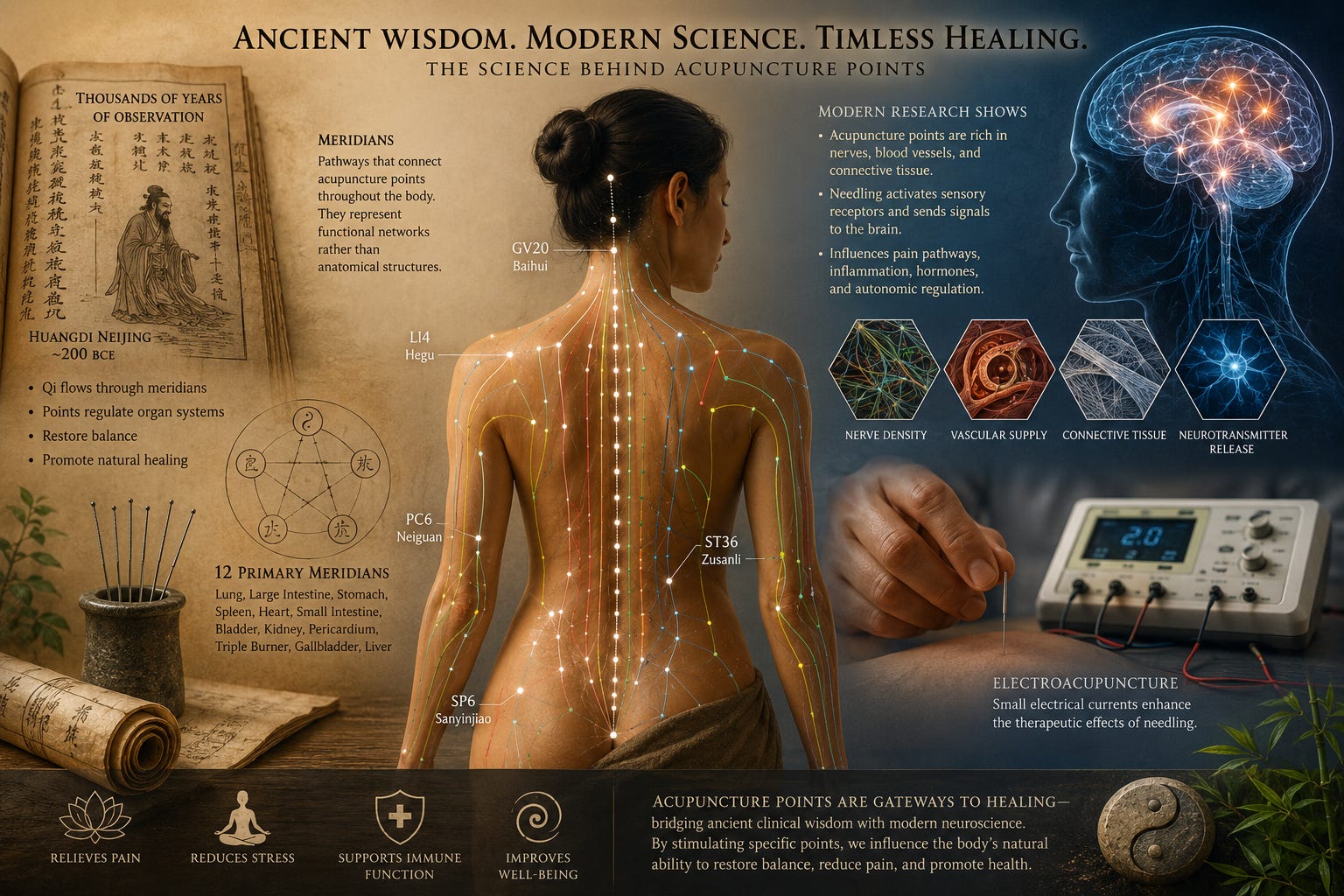
By Dr. David Traster, DC, MS, DACNB
Co-owner, The Neurologic Wellness Institute
Boca Raton • Chicago • Waukesha • Wood Dale
www.neurologicwellnessinstitute.com
Few medical systems have survived as long as acupuncture. For over two thousand years, physicians have inserted needles into specific locations on the body in an effort to reduce pain, restore health, and rebalance bodily function. To modern observers, acupuncture often appears mysterious because it is described using concepts such as Qi, meridians, Yin, and Yang—ideas that developed long before anatomy, physiology, and neuroscience existed.
Yet one of the most fascinating developments of the past several decades is that many of acupuncture’s clinical effects can now be partially explained through modern neurobiology. While the traditional explanations differ greatly from contemporary neuroscience, researchers have discovered that many acupuncture points correspond to areas rich in sensory receptors, connective tissue planes, blood vessels, and peripheral nerves capable of producing measurable effects throughout the nervous system.
Understanding acupuncture today requires appreciating both its historical origins and the scientific discoveries that have emerged over the past century.
When Were Acupuncture Points Invented?
No one knows precisely when acupuncture points were first identified. Archaeological evidence suggests that primitive forms of needling were practiced in China over 3,000 years ago using sharpened stones known as bian stones before metal needles were developed.
The first comprehensive written descriptions appeared in the Huangdi Neijing (The Yellow Emperor’s Inner Canon), written approximately between 200 BCE and 100 BCE. This foundational medical text described hundreds of acupuncture points arranged along pathways known as meridians.
Unlike modern anatomy, these points were not discovered by dissecting the human body. Instead, they evolved from centuries of clinical observation. Ancient physicians noticed that stimulating certain areas consistently relieved pain or influenced symptoms in distant regions of the body. Over generations these observations were organized into a sophisticated map that eventually included 361 classical acupuncture points located along twelve primary meridians and several extraordinary vessels.
The locations of these points became increasingly standardized over centuries as Chinese medicine evolved into a formal medical system.
What Are Acupuncture Meridians?
Meridians are conceptual pathways that connect acupuncture points throughout the body.
Traditional Chinese medicine teaches that Qi—the body’s vital life energy—flows continuously through these channels. Disease occurs when this flow becomes deficient, excessive, stagnant, or blocked. Acupuncture attempts to restore normal movement of Qi by stimulating carefully selected points.
Each meridian became associated with a major organ system including:
Lung
Large Intestine
Stomach
Spleen
Heart
Small Intestine
Bladder
Kidney
Pericardium
Triple Burner (San Jiao)
Gallbladder
Liver
Importantly, these organs are functional systems rather than purely anatomical structures. For example, the Liver meridian represents far more than the physical liver itself—it encompasses emotional regulation, tendon health, circulation, and numerous physiological relationships described within traditional Chinese medicine.
The meridian system therefore functions as an integrated physiological network rather than a literal anatomical structure.
Are Meridians Real Anatomical Structures?
This remains one of the largest scientific questions surrounding acupuncture.
Despite centuries of investigation, researchers have never identified physical tubes, vessels, or channels that correspond exactly to traditional meridians.
Instead, modern research suggests that meridians may represent functional communication networks involving several biological systems simultaneously.
Many acupuncture points lie directly over:
Peripheral nerves
Motor points
Fascial planes
Intermuscular septa
Vascular bundles
Areas of low electrical skin resistance
Dense connective tissue intersections
Rather than representing one physical structure, meridians may reflect predictable pathways through which mechanical stimulation influences multiple physiological systems simultaneously.
From a neuroscience perspective, stimulating one acupuncture point activates thousands of sensory receptors that transmit information through peripheral nerves into the spinal cord, brainstem, hypothalamus, limbic system, cerebellum, and cerebral cortex.
In other words, the “meridian” may represent a functional neurophysiological network rather than an anatomical tube.
Why Do Acupuncture Points Exist Where They Do?
One of the most intriguing findings in modern acupuncture research is that acupuncture points are not randomly distributed.
Compared with surrounding tissue, many points demonstrate:
Greater nerve density
Higher concentrations of mechanoreceptors
Rich vascular supply
Increased mast cell density
Higher connective tissue complexity
Lower electrical skin impedance
Greater collagen organization
When a needle is inserted and manipulated, it mechanically deforms connective tissue. This deformation activates mechanoreceptors, sensory nerve endings, fibroblasts, immune cells, and local vascular responses.
These signals rapidly travel through the nervous system to influence pain perception, autonomic regulation, inflammation, hormonal release, and motor control. This provides a plausible biological explanation for why certain points consistently produce stronger physiological responses than neighboring tissue.
The Purpose of Acupuncture Points in Traditional Chinese Medicine
Each acupuncture point possesses unique therapeutic properties based on centuries of clinical observation.
Some points calm pain.
Others regulate digestion.
Some influence emotional states.
Others improve circulation.
Still others affect sleep, headache frequency, nausea, or immune regulation.
Rather than treating diseases directly, acupuncture traditionally attempts to normalize physiological balance so the body can restore its own function. Modern physiology increasingly describes this concept using different language: improving autonomic regulation, reducing neuroinflammation, modulating pain pathways, and enhancing homeostasis. Although the terminology differs dramatically, both systems ultimately describe attempts to restore physiological equilibrium.
What Is Electroacupuncture According to Voll (EAV)?
Electroacupuncture According to Voll (EAV) is frequently confused with traditional electroacupuncture, but they are fundamentally different systems. EAV was developed during the 1950s by German physician Dr. Reinhold Voll. Rather than inserting needles and applying electrical stimulation, Voll measured electrical conductance at acupuncture points using a handheld probe connected to a sensitive galvanometer.
His theory proposed that each acupuncture point possessed measurable electrical characteristics reflecting the health of specific organs or physiological systems. Changes in electrical resistance were interpreted as signs of inflammation, degeneration, toxicity, allergy, or energetic imbalance. Voll also introduced the concept of testing medications by placing substances into an electrical circuit while observing changes in point measurements. This eventually evolved into various forms of electrodermal screening used in biological and integrative medicine.
Unlike traditional Chinese acupuncture, EAV relies on electrical measurements rather than the flow of Qi, and unlike conventional medicine, most of its diagnostic claims have not been consistently validated in high-quality scientific studies.
Modern research has demonstrated that skin conductance varies considerably with:
Sweat gland activity
Skin hydration
Pressure applied by the probe
Temperature
Autonomic nervous system activity
Because of these variables, EAV remains controversial and has not gained widespread acceptance within evidence-based medicine.
Electroacupuncture Versus Electroacupuncture According to Voll
The terminology can be confusing because “electroacupuncture” often refers to two completely different procedures.
Modern electroacupuncture involves inserting traditional acupuncture needles and then connecting them to a device that delivers small electrical currents between needles. Numerous clinical trials have investigated this technique for pain management, stroke rehabilitation, neuropathy, osteoarthritis, and neurological disorders.
Electroacupuncture According to Voll does not stimulate needles at all. Instead, it measures electrical conductance at the skin surface for diagnostic purposes.
The two approaches share little beyond the word “electro.”
What Does Modern Research Say About Acupuncture?
Over the past forty years, acupuncture has become one of the most extensively studied complementary therapies. The strongest evidence exists for chronic pain.
Numerous randomized clinical trials demonstrate modest but clinically meaningful improvements for:
Chronic low back pain
Knee osteoarthritis
Neck pain
Migraine prevention
Tension headaches
Postoperative nausea
Chemotherapy-induced nausea
Functional MRI studies have demonstrated that acupuncture influences activity within the insula, anterior cingulate cortex, prefrontal cortex, amygdala, hypothalamus, and brainstem.
These regions are heavily involved in:
Pain perception
Emotional regulation
Autonomic control
Attention
Interoception
Researchers have also observed measurable effects on endogenous opioid release, serotonin pathways, dopamine signaling, inflammatory cytokines, vagal activity, and descending pain inhibitory systems. Although debate continues regarding placebo contributions, it is increasingly clear that acupuncture produces genuine physiological effects beyond expectation alone.
Acupuncture Points with the Strongest Scientific Evidence
Not every acupuncture point has been studied equally. Several points have accumulated particularly strong research support.
LI4 (Hegu)
Located between the thumb and index finger, LI4 is one of the most researched acupuncture points. Studies associate LI4 with reductions in headache pain, dental pain, postoperative pain, facial pain, and stress-related symptoms. Functional imaging demonstrates widespread modulation of pain-processing regions following stimulation.
ST36 (Zusanli)
Located just below the knee, ST36 is perhaps the most extensively investigated acupuncture point in modern science.
Research suggests benefits for:
Immune modulation
Gastrointestinal function
Fatigue
Inflammation
Recovery following illness
Animal studies consistently demonstrate activation of vagal anti-inflammatory pathways following ST36 stimulation.
PC6 (Neiguan)
Located on the inner forearm, PC6 has one of the strongest evidence bases for reducing nausea and vomiting.
Clinical guidelines frequently recommend stimulation of PC6 for:
Postoperative nausea
Chemotherapy-induced nausea
Pregnancy-related nausea
Motion sickness
GV20 (Baihui)
Situated at the top of the head, GV20 has been studied in stroke rehabilitation, depression, cognitive impairment, and autonomic regulation. Functional imaging suggests effects on widespread cortical networks involved in attention and arousal.
SP6 (Sanyinjiao)
Located above the inner ankle, SP6 has been investigated for chronic pelvic pain, menstrual discomfort, insomnia, and anxiety.
Several studies demonstrate measurable autonomic changes following stimulation.
BL23 and BL25
These lumbar points have been widely studied in chronic low back pain and often appear in successful treatment protocols.
Acupuncture Through the Lens of Neuroscience
Perhaps the greatest shift in acupuncture research has been moving away from asking whether Qi exists toward understanding how sensory stimulation alters nervous system function. Every acupuncture needle activates an enormous amount of sensory information entering the brain.
These signals interact with spinal gating mechanisms, descending pain pathways, autonomic reflexes, inflammatory cascades, neurochemical release, and cortical plasticity. From this perspective, acupuncture becomes less mysterious and more understandable as a sophisticated form of targeted neuromodulation.
Ancient physicians lacked the vocabulary of neuroscience, connective tissue biology, and neuroimmunology. Instead, they described physiological relationships using the language available to them: Qi, meridians, Yin, and Yang.
Modern science is gradually translating portions of those observations into measurable biological mechanisms. While many traditional concepts remain difficult to validate anatomically, increasing evidence suggests that acupuncture points are biologically unique regions capable of influencing the nervous system through complex interactions among peripheral nerves, fascia, immune cells, connective tissue, and the brain itself.
The future of acupuncture research will likely focus less on proving ancient theories and more on identifying the precise neural circuits and physiological mechanisms that explain why specific points reliably influence pain, autonomic regulation, inflammation, digestion, mood, and recovery. In many ways, the convergence of traditional acupuncture and modern neuroscience represents not the replacement of one system by another, but the gradual translation of an ancient clinical map into the language of contemporary biology.
REFERENCES
Langevin, H. M., & Yandow, J. A. (2002). Relationship of acupuncture points and meridians to connective tissue planes. The Anatomical Record, 269(6), 257–265.
Vickers, A. J., Cronin, A. M., Maschino, A. C., Lewith, G., MacPherson, H., Foster, N. E., Sherman, K. J., Witt, C. M., & Linde, K. (2012). Acupuncture for chronic pain: Individual patient data meta-analysis. Archives of Internal Medicine, 172(19), 1444–1453.
Zhao, Z. Q. (2008). Neural mechanism underlying acupuncture analgesia. Progress in Neurobiology, 85(4), 355–375.
Napadow, V., Ahn, A., Longhurst, J., Lao, L., Stener-Victorin, E., Harris, R., & Langevin, H. M. (2008). The status and future of acupuncture mechanism research. Journal of Alternative and Complementary Medicine, 14(7), 861–869.
Oliveira, A. (2016). Electroacupuncture according to Voll: Historical background and literature review. Meridians: Journal of Acupuncture and Oriental Medicine, 3(1), 5–16.
Really thought-provoking perspective. Acupuncture points have been mapped for centuries, and advances in neurobiology, connective tissue research, and pain science are beginning to shed light on how some of these effects might be explained through contemporary physiology. Perhaps one of the most exciting aspects of integrative medicine is that it encourages us to ask not whether ancient or modern frameworks are right, but how rigorous science can help us better understand where they converge and where they differ. Thanks for sharing this insightful overview.
I get acupuncture monthly and I feel it helps me in everything from inflammation, digestion and improved emotional regulation