
Complex Regional Pain Syndrome: When the Nervous System Becomes Stuck in a State of Protection
The Neurology, Autonomics, and Immune System Connections in CRPS

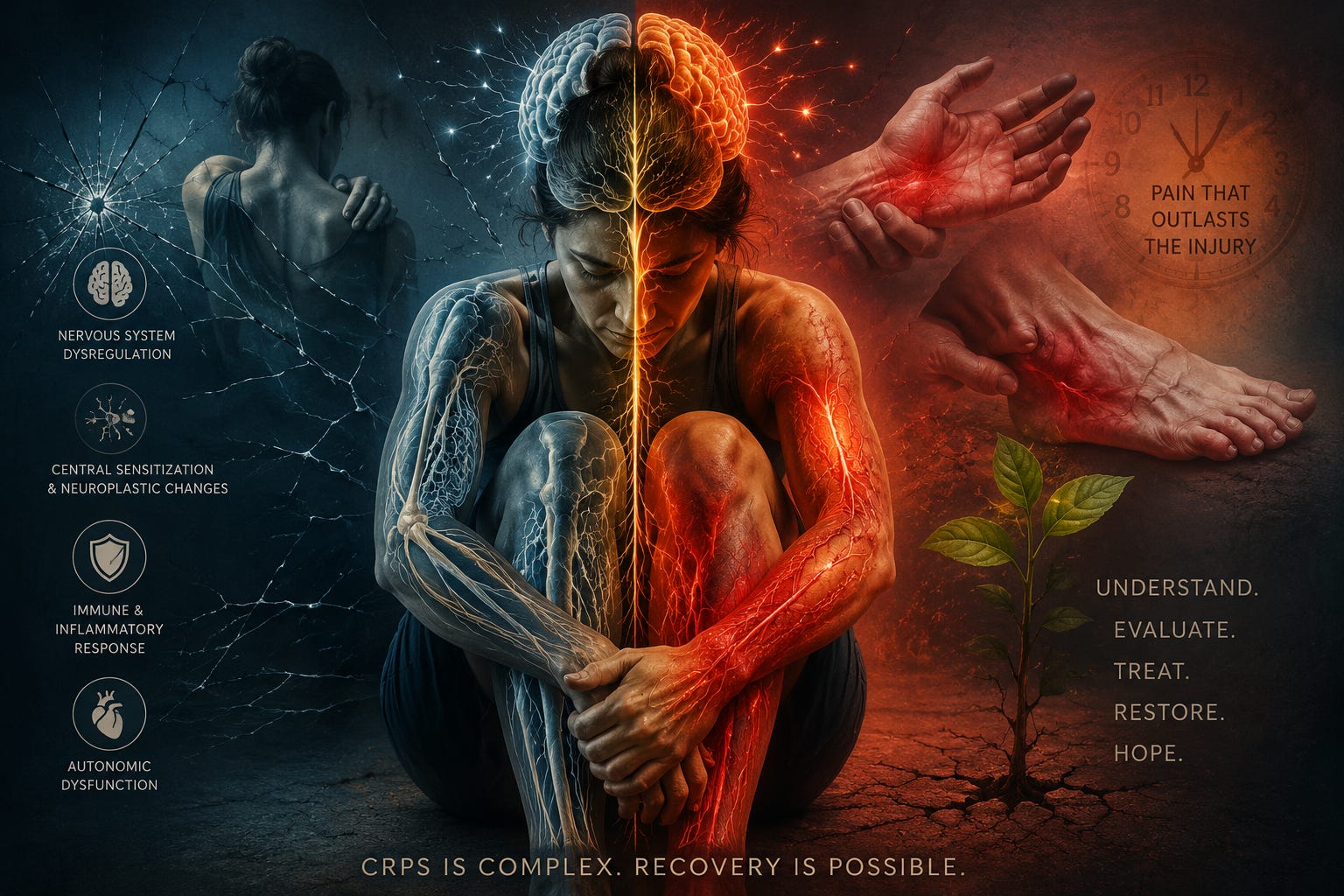
By Dr. David Traster, DC, MS, DACNB
Co-owner, The Neurologic Wellness Institute
Boca Raton • Chicago • Waukesha • Wood Dale
www.neurologicwellnessinstitute.com
What Is Complex Regional Pain Syndrome?
Complex Regional Pain Syndrome (CRPS) is one of the most challenging and misunderstood chronic pain conditions in medicine. It is characterized by severe pain that is disproportionate to the original injury and is often accompanied by changes in sensation, circulation, movement, skin appearance, temperature regulation, and autonomic nervous system function.
CRPS most commonly develops after an injury, surgery, fracture, sprain, or even a seemingly minor trauma. In some cases, no obvious triggering event can be identified. While the initial injury may heal, the nervous system continues to behave as if the threat remains present. The result is a state of persistent pain, heightened sensitivity, and abnormal nervous system activity.
Rather than being solely a problem of damaged tissues, CRPS is increasingly viewed as a disorder involving abnormal interactions between the peripheral nervous system, central nervous system, immune system, and autonomic nervous system.
The History of CRPS and the Evolution of Its Name
The condition now known as CRPS has been recognized for over 150 years.
During the American Civil War, neurologist Silas Weir Mitchell described soldiers who developed severe burning pain following nerve injuries. He referred to the condition as “causalgia,” a term derived from Greek words meaning “burning pain.”
Throughout the twentieth century, the disorder became known by several names, including:
Reflex Sympathetic Dystrophy (RSD)
Sudeck’s Atrophy
Algodystrophy
Shoulder-Hand Syndrome
Causalgia
As scientific understanding evolved, it became clear that the sympathetic nervous system was not the sole cause of the condition. Many patients exhibited abnormalities involving sensory processing, motor control, cortical reorganization, inflammation, and immune activation.
In 1994, the International Association for the Study of Pain introduced the term Complex Regional Pain Syndrome to better reflect the complexity of the disorder and avoid assumptions about a single underlying mechanism.
Today, CRPS is generally divided into:
CRPS Type I: No identifiable major nerve injury is found.
CRPS Type II: A distinct nerve injury can be identified.
Both forms often present with very similar symptoms.
What Causes CRPS?
There is no single cause of CRPS. Instead, it appears to result from multiple interacting biological systems.
Potential contributors include:
Peripheral Nervous System Sensitization
Following injury, pain receptors may become excessively sensitive. Signals that would normally be interpreted as harmless can become painful.
Central Sensitization
The spinal cord and brain may amplify incoming sensory information. Normal touch, movement, temperature changes, or pressure may be perceived as painful.
Autonomic Nervous System Dysfunction
Abnormal regulation of blood vessels, sweating, skin temperature, and circulation is common. This is why many patients develop color changes, temperature asymmetries, and swelling.
Neuroinflammation
Elevated inflammatory signaling molecules and activation of immune cells within the nervous system may contribute to persistent pain and tissue changes.
Cortical Reorganization
Brain imaging studies have demonstrated changes in sensory and motor regions of the brain. The affected limb may become poorly represented within the brain’s internal map, contributing to altered movement and perception.
Immune Dysfunction
Some researchers have identified evidence of autoimmune activity and abnormal inflammatory responses in subsets of CRPS patients, suggesting that immune mechanisms may play a role in disease progression.
Common Symptoms of CRPS
CRPS can affect nearly every aspect of nervous system function.
Pain
Pain is the hallmark symptom.
Patients often describe:
Burning pain
Deep aching pain
Electric shock sensations
Stabbing pain
Crushing pain
Extreme sensitivity
Pain is frequently far greater than would be expected from the original injury.
Allodynia
Allodynia occurs when normally non-painful stimuli become painful.
Examples include:
Clothing touching the skin
Light touch
Air movement
Water contact
Bed sheets resting on the limb
Hyperalgesia
Painful stimuli become excessively painful compared to normal.
Temperature Changes
The affected limb may become:
Hot
Cold
Alternating between both
Temperature differences between limbs can sometimes be dramatic.
Skin Color Changes
The limb may appear:
Red
Purple
Blue
Pale
Mottled
These changes often fluctuate throughout the day.
Swelling
Persistent edema is common, particularly during early stages.
Sweating Abnormalities
Patients may notice:
Excessive sweating
Reduced sweating
Uneven sweating patterns
Motor Dysfunction
Many individuals develop:
Weakness
Tremor
Muscle spasms
Dystonia
Loss of coordination
Reduced dexterity
Trophic Changes
Long-standing CRPS may produce:
Changes in hair growth
Changes in nail growth
Skin thinning
Skin thickening
Muscle atrophy
Bone loss
Cognitive and Emotional Symptoms
Many patients also experience:
Brain fog
Fatigue
Sleep disturbance
Anxiety
Depression
These symptoms are often secondary consequences of chronic pain and altered nervous system function.
How Is CRPS Diagnosed?
There is no single blood test, imaging study, or biomarker that definitively diagnoses CRPS.
Diagnosis remains primarily clinical.
The Budapest Criteria
The most widely accepted diagnostic criteria are the Budapest Criteria.
Diagnosis requires:
Continuing pain disproportionate to the inciting event
Symptoms in multiple categories
Objective findings on examination
No better explanation for the presentation
Categories include:
Sensory abnormalities
Vasomotor abnormalities
Sudomotor abnormalities
Motor and trophic abnormalities
Testing Used in CRPS Evaluation
Although no single test confirms CRPS, several studies may support the diagnosis or rule out alternative conditions.
Physical Examination
Clinicians assess:
Temperature differences
Color changes
Swelling
Sensory abnormalities
Range of motion
Strength
Coordination
Quantitative Sensory Testing
Measures responses to:
Touch
Pressure
Temperature
Pain stimuli
Thermography
Infrared imaging may identify temperature asymmetries between limbs.
Triple-Phase Bone Scan
May demonstrate characteristic changes in bone metabolism, particularly in earlier stages.
X-Rays
Can reveal regional bone loss in chronic cases.
MRI
May identify:
Tissue swelling
Bone marrow changes
Alternative diagnoses
Autonomic Testing
Some patients demonstrate abnormalities in:
Heart rate variability
Sudomotor function
Vasomotor control
Sympathetic regulation
Electromyography and Nerve Conduction Studies
These tests help identify nerve injuries and distinguish CRPS from other neuropathic disorders.
Treatment Approaches for CRPS
The earlier CRPS is recognized and treated, the better the chances of recovery.
Modern treatment generally involves a multidisciplinary approach.
Physical and Occupational Therapy
Movement remains one of the most important treatments.
Goals include:
Restoring normal movement
Preventing contractures
Reducing fear of movement
Improving function
Therapy is usually introduced gradually to avoid excessive symptom flares.
Graded Motor Imagery
This approach attempts to normalize brain representations of the affected limb through:
Left-right discrimination training
Motor imagery exercises
Mirror therapy
Mirror Therapy
Using a mirror to create the illusion of normal movement can reduce pain and improve motor function in some patients.
Pain Management
Depending on the individual, medications may include:
Gabapentin
Pregabalin
Duloxetine
Amitriptyline
Topical medications
Bisphosphonates
Short-term corticosteroids
Responses vary considerably between patients.
Sympathetic Blocks
Targeted nerve blocks may provide temporary relief in selected individuals.
Neuromodulation
More advanced cases may benefit from:
Spinal cord stimulation
Dorsal root ganglion stimulation
These approaches can reduce pain and improve quality of life in carefully selected patients.
Psychological Support
Because chronic pain affects emotional health, psychological interventions often help patients develop strategies for coping, reducing fear, and improving resilience.
Functional Neurology and Neuroplasticity-Based Rehabilitation
Emerging approaches increasingly focus on the role of central nervous system dysfunction in CRPS. Rehabilitation strategies may aim to improve sensory processing, normalize autonomic regulation, enhance motor control, and promote neuroplastic changes within affected neural networks.
These approaches are based on the understanding that CRPS involves not only the injured limb but also altered processing within the brain, spinal cord, and autonomic nervous system.
The Future of CRPS Research
CRPS is no longer viewed simply as a pain disorder. It is increasingly recognized as a condition involving complex interactions between pain pathways, autonomic regulation, immune signaling, motor systems, and brain function.
Research continues to explore autoimmune mechanisms, neuroinflammation, cortical reorganization, autonomic dysfunction, and novel neuromodulation strategies. As our understanding evolves, treatment is moving away from symptom suppression alone and toward restoring normal nervous system function.
For many patients, CRPS can be life-altering. Yet growing evidence suggests that early recognition, comprehensive evaluation, and individualized rehabilitation may offer meaningful improvements in pain, function, and quality of life. The more we understand the nervous system’s role in chronic pain, the more opportunities emerge to help patients reclaim movement, independence, and hope.
References
Birklein F, Schlereth T. Complex regional pain syndrome—significant progress in understanding. Neurology. 2015;84(8):861-862.
Bruehl S. Complex regional pain syndrome. BMJ. 2015;351.
Bruehl S. An update on the pathophysiology of complex regional pain syndrome. Anesthesiology. 2010;113(3):713-725.
Goebel A, Barker CH, Turner-Stokes L, et al. Complex regional pain syndrome in adults: UK guidelines for diagnosis, referral and management in primary and secondary care. Rheumatology. 2018;57(2).
Harden RN, Bruehl S, Perez RS, et al. Validation of proposed diagnostic criteria (the Budapest Criteria) for Complex Regional Pain Syndrome. Pain. 2010;150(2):268-274.
Marinus J, Moseley GL, Birklein F, et al. Clinical features and pathophysiology of complex regional pain syndrome. Lancet Neurology. 2011;10(7):637-648.
Moseley GL. Graded motor imagery for pathologic pain: A randomized controlled trial. Neurology. 2006;67(12):2129-2134.
Shim H, Rose J, Halle S, Shekane P. Complex regional pain syndrome: A narrative review for the practising clinician. British Journal of Anaesthesia. 2019;123(2).
van Velzen GAJ, Perez RSGM, van Gestel MA, et al. Health-related quality of life in 975 patients with complex regional pain syndrome type 1. Pain. 2014;155(3):629-634.
Wertli MM, Brunner F, Steurer J, Held U. Usefulness of bone scintigraphy for the diagnosis of Complex Regional Pain Syndrome 1: A systematic review and meta-analysis. PLoS One. 2017;12(3).
Is this the same as polyneuropathy ?
This is a cogent explanation of a complex syndrome and the need for a multidisciplinary approach. But it doesnot deal with discovering the ROOT CAUSE, and so addresses only symptom relief. This why I continue to refer to our medical ‘system’ as SICK CARE rather than Healthcare.
Symptom management is not enough. Until we understand and can delineate a root cause - even if multidimensional, multisystemic - such approaches only manage symptoms, but change nothing for patients. And that doesn’t even account for negative effects of pharmaceuticals that can make matters worse in the long run.