
CTE and the Changing Landscape of Brain Injury: The Invisible Accumulation
How Repetitive Head Trauma Quietly Reshapes the Brain Over Time

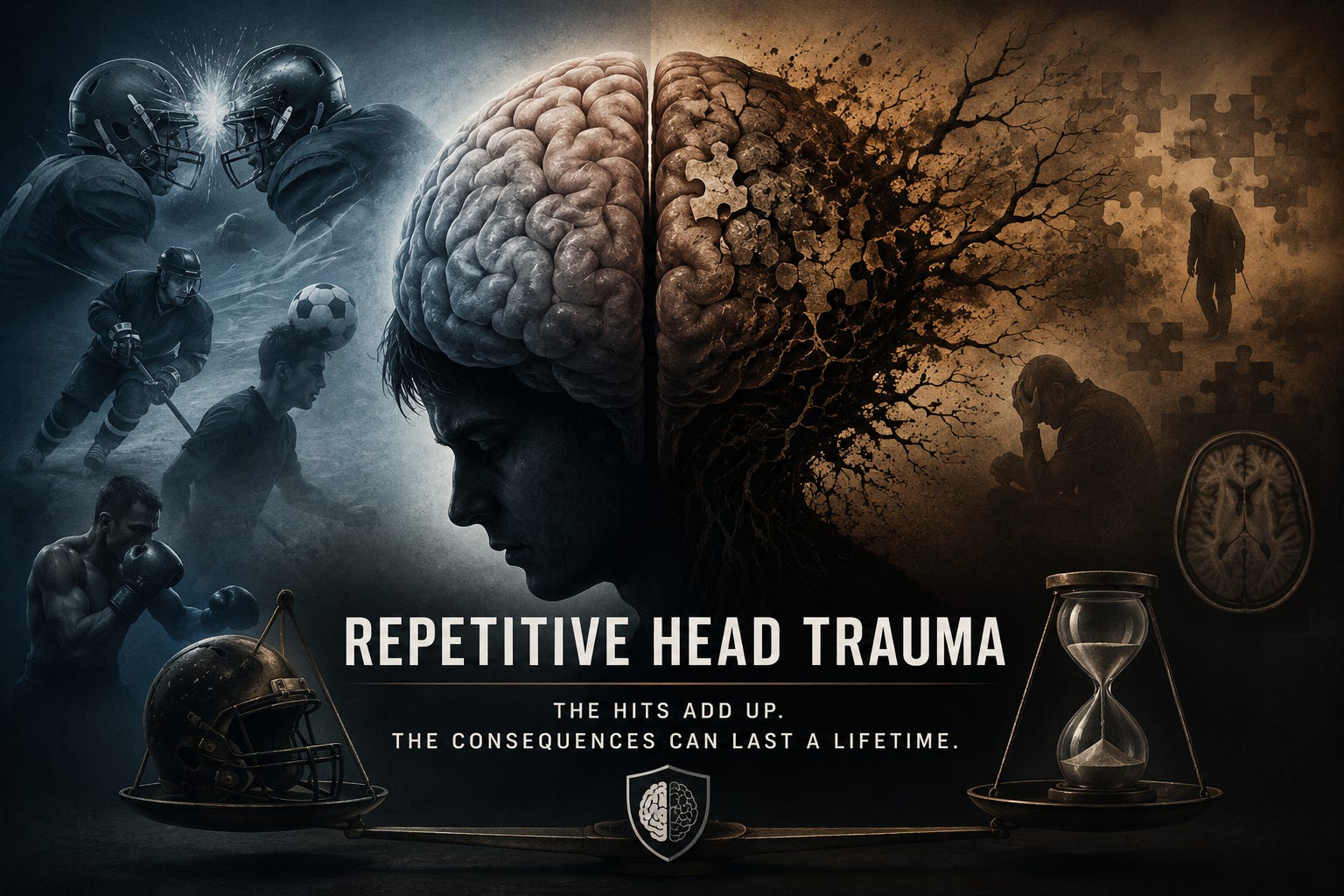
By Dr. David Traster, DC, MS, DACNB
Co-owner, The Neurologic Wellness Institute
Boca Raton • Chicago • Waukesha • Wood Dale
www.neurologicwellnessinstitute.com
For decades, concussions were often treated like temporary glitches in the nervous system. An athlete “got their bell rung,” rested for a few days, and returned to play. If symptoms improved and imaging looked normal, the assumption was that the brain had healed.
Modern neuroscience tells a far more complex story.
Researchers now understand that repetitive head trauma—including both diagnosed concussions and smaller, often unnoticed impacts—can produce cumulative effects on the brain over time. The concern is no longer limited to severe traumatic brain injury. Even repeated low-level impacts may alter brain structure, metabolism, inflammation, vascular integrity, and long-term neurological function.
This does not mean every person who experiences concussions will develop long-term disease. Many recover well. But the research increasingly shows that repeated exposure to head impacts raises the risk of cognitive, emotional, behavioral, and neurodegenerative problems in a subset of individuals.
The Brain Was Never Designed for Repeated Mechanical Trauma
The human brain is soft, highly organized tissue suspended in fluid inside a rigid skull. During rapid acceleration, deceleration, or rotational forces, the brain does not simply move—it deforms. Axons stretch, membranes disrupt, blood flow shifts, and metabolic demand spikes.
A concussion is not just a “bruise.” It is a global neurophysiological event involving:
Ionic shifts
Glutamate excitotoxicity
Mitochondrial dysfunction
Reduced cerebral blood flow
Neuroinflammation
Network-level disruption
F=maF=maF=ma
Each impact represents a mechanical force applied to neural tissue. When these forces occur repeatedly—especially before full recovery—the brain may not fully return to baseline. Instead, it accumulates stress.
Over time, this cumulative load can alter how neural systems function, even if each individual hit seemed “minor.”
Concussions Are Only Part of the Story
One of the most important shifts in research is the realization that diagnosed concussions may not be the best predictor of long-term risk.
Instead, cumulative exposure matters.
Athletes and individuals exposed to repetitive head impacts—football linemen, soccer players heading the ball, boxers, martial artists, military personnel exposed to blast waves—may experience hundreds or thousands of smaller impacts that never meet formal concussion criteria.
Yet these subconcussive impacts may still:
Disrupt white matter integrity
Alter brain connectivity
Trigger inflammatory responses
Influence long-term brain health
The modern question is no longer:
“How many concussions did you have?”
It is:
“How much total neurological stress did your brain experience over time?”
Chronic Traumatic Encephalopathy (CTE)
The condition most commonly associated with repetitive head trauma is Chronic Traumatic Encephalopathy, or CTE.
CTE is a progressive neurodegenerative disease characterized by abnormal accumulation of tau protein in specific patterns within the brain. It was first described in boxers, historically called “punch-drunk syndrome,” and has since been identified in athletes across multiple sports and in individuals with repeated head trauma exposure.
Symptoms associated with CTE may include:
Memory loss
Executive dysfunction
Depression
Anxiety
Emotional instability
Impulsivity
Aggression
Sleep disturbance
Parkinsonian features
Progressive cognitive decline
One critical point: CTE can currently only be definitively diagnosed after death through neuropathological examination. While research into imaging and blood biomarkers is advancing rapidly, there is no universally accepted method for diagnosing CTE in living patients at this time.
Tau, Inflammation, and Degeneration
Tau protein plays a normal role in stabilizing neuronal structure. After repetitive trauma, however, tau may become misfolded and accumulate abnormally, particularly around small blood vessels and in cortical folds.
But tau is only part of the picture.
Repetitive head trauma has been associated with:
Chronic microglial activation
Persistent neuroinflammation
Blood-brain barrier disruption
Oxidative stress
Microvascular injury
White matter degeneration
Impaired waste clearance through the glymphatic system
Altered immune signaling
Many researchers now believe that chronic inflammation—rather than a single injury—may be one of the primary drivers of long-term neurodegeneration.
Network-Level Injury, Not Just Local Damage
The brain does not operate in isolated regions. It functions through networks.
Repetitive head trauma often produces diffuse injury across multiple systems, including:
Frontal lobes (executive function, decision-making)
Temporal lobes (memory, emotional processing)
Limbic system (emotion, stress regulation)
White matter tracts (communication pathways)
Corpus callosum (interhemispheric communication)
Brainstem (arousal, autonomic regulation)
Vestibular pathways (balance, spatial orientation)
This explains why symptoms can vary so widely.
Some individuals experience cognitive decline.
Others develop mood disturbances.
Others struggle with dizziness, headaches, visual motion sensitivity, or autonomic dysfunction.
It is not a single symptom problem. It is a systems problem.
Emotional and Psychiatric Effects
One of the most important—and often underrecognized—effects of repetitive head trauma is its impact on emotional regulation.
Research has shown increased rates of:
Depression
Anxiety
Irritability
Impulsivity
Aggression
Substance misuse
Suicidal ideation in some cases
This does not mean brain injury is the sole cause of these conditions. But damage to frontal and limbic networks—combined with chronic inflammation and altered neurotransmitter signaling—can significantly affect emotional stability.
The brain systems that regulate mood are the same systems that are highly vulnerable to diffuse mechanical stress.
The Developing Brain: A Unique Risk Window
Youth athletes represent a particularly important population in this discussion.
The brain continues developing into early adulthood. During this time, critical processes are occurring:
Synaptic pruning
Myelination
Network refinement
Metabolic optimization
Repetitive head trauma during this developmental window may interfere with these processes.
This has led to growing recommendations to:
Limit contact exposure in youth sports
Delay introduction of high-impact play
Reduce repetitive drills involving head contact
Improve early detection of subtle symptoms
Emphasize longer recovery periods
The conversation is shifting from reaction to prevention.
Why Some People Develop Problems—and Others Do Not
One of the most important and still unanswered questions is variability.
Not everyone exposed to repetitive head trauma develops long-term neurological disease.
Possible factors influencing this include:
Genetic susceptibility
Total lifetime exposure
Recovery time between impacts
Age at first exposure
Sleep quality
Cardiovascular and metabolic health
Inflammatory status
Substance use
Overall lifestyle
The brain’s resilience is not the same for everyone.
Understanding why remains one of the most important areas of ongoing research.
Prevention Is the Future
There is currently no cure for CTE or many long-term consequences of repetitive brain trauma.
This makes prevention essential.
Modern approaches focus on:
Reducing unnecessary head impacts
Properly identifying and managing concussions
Allowing full recovery before return to activity
Avoiding cumulative overload
Improving neck strength and biomechanics
Monitoring subtle neurological changes over time
The future of brain health in sports and high-risk environments may depend less on treating injuries after they occur—and more on reducing total neurological burden throughout life.
The Bigger Picture
The science of repetitive head trauma is still evolving, but one message is becoming increasingly clear:
The brain keeps track.
Even when symptoms fade, underlying biological processes may continue—adapting, compensating, inflaming, and remodeling neural systems over time.
Repetitive head trauma is not just a momentary event. It is an exposure.
And like many exposures in medicine, its true impact is often revealed not immediately—but years down the line, as the brain tells the story of everything it has experienced.
References
McKee AC, Stein TD, Nowinski CJ, et al. The spectrum of disease in chronic traumatic encephalopathy. Brain. 2013;136(1):43–64.
Mez J, Daneshvar DH, Kiernan PT, et al. Clinicopathological evaluation of chronic traumatic encephalopathy in players of American football. JAMA. 2017;318(4):360–370.
Giza CC, Hovda DA. The new neurometabolic cascade of concussion. Neurosurgery. 2014;75(Suppl 4):S24–S33.
McCrory P, Meeuwisse W, Dvorak J, et al. Consensus statement on concussion in sport. Br J Sports Med. 2017;51(11):838–847.
Bailes JE, Petraglia AL, Omalu BI, Nauman E, Talavage T. Role of subconcussion in repetitive mild traumatic brain injury. J Neurosurg. 2013;119(5):1235–1245.
Stern RA, Daneshvar DH, Baugh CM, et al. Clinical presentation of chronic traumatic encephalopathy. Neurology. 2013;81(13):1122–1129.
Montenigro PH, Bernick C, Cantu RC. Clinical features of repetitive traumatic brain injury and chronic traumatic encephalopathy. Brain Pathol. 2015;25(3):304–317.
Prins ML, Hales A, Reger M, Giza CC, Hovda DA. Repetitive mild traumatic brain injury: mechanisms of cerebral vulnerability. J Neurotrauma. 2013;30(1):30–38.
Johnson VE, Stewart W, Smith DH. Axonal pathology in traumatic brain injury. Exp Neurol. 2013;246:35–43.
Smith DH, Johnson VE, Stewart W. Chronic neuropathologies of single and repetitive TBI: substrates of dementia? Nat Rev Neurol. 2013;9(4):211–221.
Great article with tremendous insight and information. One of the questions for me comes from having met someone who was working with young athletes who had suffered the concussions at some level in their sports. They were using red light therapy to work with them and said that they saw improvement in many. I haven't researched that at all, but curious if you have found that to be the case.