
Eczema Beyond the Skin
The Forgotten Treatments, Immune Physiology, and Neurobiology of Atopic Dermatitis

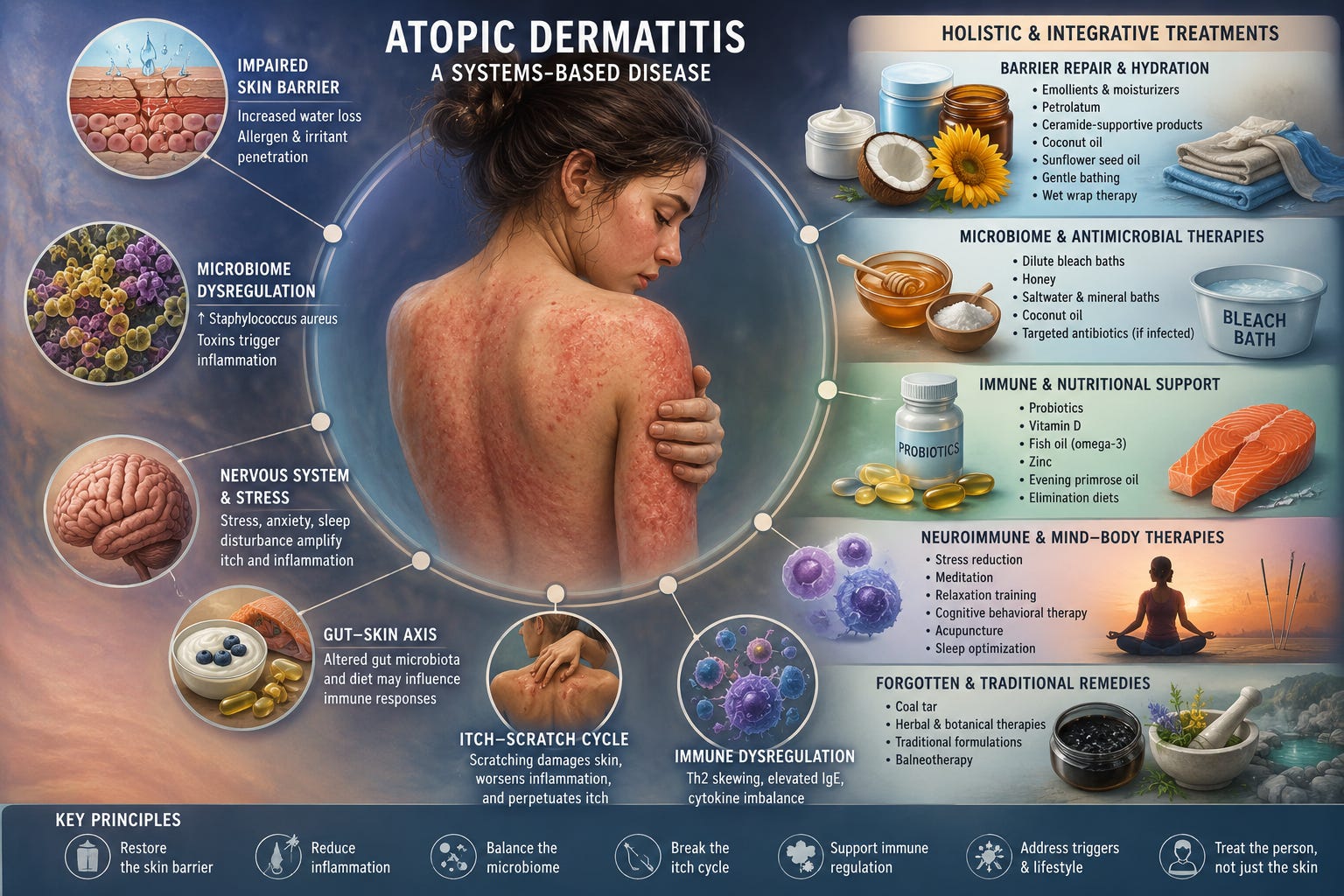
By Dr. David Traster, DC, MS, DACNB
Co-owner, The Neurologic Wellness Institute
Boca Raton • Chicago • Waukesha • Wood Dale
www.neurologicwellnessinstitute.com
For decades, eczema—also called atopic dermatitis—was treated largely as a superficial skin disorder. The approach was often straightforward: reduce inflammation, suppress the rash, stop the itching. But modern research has increasingly revealed that eczema is far more complicated than a simple skin irritation. It is a disorder involving the immune system, nervous system, skin barrier, microbiome, stress physiology, environment, and in some cases even the gut.
One fascinating review article explored not only conventional therapies, but also many alternative, complementary, and historically forgotten treatments that have been used to help patients with eczema. The paper did not present these therapies as miracle cures. Instead, it showed how many of them may target specific components of eczema physiology—barrier dysfunction, bacterial overgrowth, immune dysregulation, neuroinflammation, or chronic itch signaling.
The article paints eczema as a systems-based disease in which inflammation, microbes, stress, barrier breakdown, and scratching continuously amplify one another.
The Skin Barrier Is Not Just Skin
Healthy skin acts as one of the body’s most important immune and neurological interfaces with the outside world. It prevents excessive water loss, protects against allergens and microbes, and constantly communicates with the immune system and sensory nerves.
In eczema, this barrier becomes compromised. Tiny defects develop between skin cells, allowing moisture to escape and irritants to penetrate more deeply into tissue. The immune system then responds aggressively to exposures that would normally be harmless.
Research discussed in the article highlights abnormalities in:
Skin lipids
Ceramide content
Filaggrin proteins
Water retention
Local immune signaling
This helps explain why eczema skin becomes dry, inflamed, hypersensitive, and prone to cracking and infection.
Because of this, one of the central treatment goals in eczema is restoration of the barrier itself.
Moisturizers and Barrier Repair Therapies
The article strongly emphasizes moisturization as a foundational therapy rather than merely cosmetic skin care.
Barrier repair treatments discussed include:
Emollients
Petrolatum-based occlusives
Hydrating creams
Ceramide-supportive products
Natural oils
Several oils were specifically discussed.
Coconut Oil
Virgin coconut oil has gained interest because it may provide both moisturizing and antimicrobial effects. Studies have shown it may help reduce colonization of Staphylococcus aureus, a bacterium frequently elevated in eczema patients.
Potential mechanisms include:
Barrier support
Reduced water loss
Antimicrobial activity
Reduced inflammation
Sunflower Seed Oil
Sunflower seed oil was discussed as another potentially beneficial barrier-supportive oil that may improve hydration without some of the irritation associated with other plant oils.
Bathing and Hydration Strategies
The article also discussed:
Frequent moisturizing
Controlled bathing
Hydration immediately after bathing
Occlusive layering
These strategies help trap water within the skin and reduce barrier disruption.
Wet Wrap Therapy
One of the most strongly supported nonpharmaceutical approaches discussed was wet wrap therapy.
This technique involves:
Applying moisturizer and/or topical medication
Covering the skin with damp fabric
Adding a dry outer layer
This creates prolonged hydration and cooling effects.
Potential benefits include:
Reduced itching
Enhanced medication absorption
Improved hydration
Reduced scratching
Faster flare reduction
Wet wraps are often especially helpful in children with severe eczema flares.
Conventional Medical Therapies Reviewed
Although the article focused on complementary and forgotten treatments, it also acknowledged the role of conventional therapies.
These included:
Topical corticosteroids
Topical calcineurin inhibitors
Antihistamines
Antibiotics when secondary infection occurs
However, the authors emphasized that these treatments often do not fully address:
Barrier dysfunction
Microbiome imbalance
Stress physiology
Environmental triggers
Chronic itch sensitization
The Skin Microbiome and Antimicrobial Therapies
One of the most important themes in the article was the role of bacterial imbalance in eczema.
Many eczema patients develop excessive Staphylococcus aureus colonization. These bacteria can produce toxins that worsen inflammation and immune activation.
This has led to growing interest in antimicrobial therapies.
Bleach Baths
Dilute bleach baths were discussed as a low-cost intervention that may reduce bacterial burden and decrease eczema severity in some patients.
The concentrations used medically are extremely diluted and intended to reduce microbial overgrowth rather than sterilize the skin.
Potential benefits:
Reduced bacterial toxins
Reduced inflammation
Reduced recurrent infections
Improved flare control
Honey
Honey was discussed because of its:
Antimicrobial properties
Wound-healing potential
Anti-inflammatory effects
Historically, honey has been used in various skin conditions because it may inhibit bacterial growth while supporting tissue healing.
Saltwater and Mineral Bathing
The article also reviewed:
Saltwater therapy
Mineral baths
Balneotherapy
These therapies may help:
Reduce bacterial burden
Calm inflammation
Improve hydration
Support skin healing
This may partly explain why some eczema patients improve in ocean environments or at mineral-rich spas.
Coal Tar Therapy
Coal tar is one of the oldest dermatologic treatments and was highlighted as a “forgotten” therapy.
Although less commonly used today, coal tar has historically been used for inflammatory skin conditions because of potential:
Anti-inflammatory effects
Antipruritic effects
Skin turnover regulation
Its use has declined partly because of odor, messiness, irritation risk, and newer pharmaceutical options.
Acupuncture and Neuroimmune Regulation
The article explored acupuncture as a possible adjunctive therapy for eczema.
Potential mechanisms discussed included:
Nervous system modulation
Reduced itch signaling
Stress reduction
Altered inflammatory pathways
Although evidence remains mixed, some studies suggest acupuncture may help reduce itch intensity and improve quality of life in certain patients.
Stress, the Nervous System, and Eczema
The paper strongly emphasized the relationship between stress and inflammatory skin disease.
Stress may:
Increase inflammatory cytokines
Alter cortisol signaling
Heighten itch perception
Increase sympathetic nervous system activity
Worsen sleep quality
The authors discussed psychoneuroimmunology—the interaction between the brain, nervous system, and immune system—as an important framework for understanding eczema.
Because of this, therapies aimed at calming the nervous system may indirectly improve skin health.
These included:
Meditation
Relaxation training
Behavioral therapy
Stress management
Sleep optimization
The Itch-Scratch Cycle
One of the most important clinical concepts reviewed was the itch-scratch cycle.
Scratching:
Damages the skin barrier
Increases inflammation
Promotes bacterial entry
Sensitizes itch pathways in the brain
Increases immune activation
Over time, chronic itch may become neurologically reinforced within the central nervous system.
This means eczema is not only occurring in the skin. The brain itself may become increasingly efficient at generating itch responses.
Probiotics and the Gut-Skin Axis
The article reviewed growing evidence linking gut microbes to immune regulation and eczema severity.
Potential probiotic mechanisms include:
Increased T regulatory cell activity
Reduced Th2 dominance
Improved intestinal barrier integrity
Reduced systemic inflammation
The evidence was described as mixed, but promising in some populations, especially children.
Not all probiotic strains appear equally effective.
Dietary Therapies and Supplements
Several nutritional interventions were reviewed.
Fish Oil
Fish oil may potentially influence:
Inflammatory signaling
Cell membrane composition
Cytokine production
Vitamin D
Vitamin D was discussed because of its effects on:
Immune regulation
Skin barrier function
Antimicrobial peptide production
Zinc
Zinc may support:
Tissue healing
Immune function
Skin repair mechanisms
Evening Primrose Oil
Evening primrose oil has historically been used because of its gamma-linolenic acid (GLA) content, which may influence inflammatory pathways.
Elimination Diets
Elimination diets were discussed cautiously.
The article emphasized:
Food triggers are not universal
Some children with allergic tendencies may benefit
Overly restrictive diets can become problematic
The evidence was described as highly variable between patients.
Botanical and Traditional Therapies
The review also explored a variety of botanical and traditional approaches.
These included:
Herbal therapies
Traditional remedies
Plant-based anti-inflammatory compounds
The authors cautioned that evidence quality varies significantly and that some herbal preparations may themselves cause allergic reactions in susceptible individuals.
A Systems-Based View of Eczema
Perhaps the most important message from the article is that eczema is not caused by one single mechanism.
It involves interactions between:
The skin barrier
Immune activation
Bacterial ecosystems
Environmental triggers
Stress physiology
The nervous system
Sleep
Diet
Microbial exposures
Chronic itch signaling
This helps explain why many patients improve most with multidimensional treatment strategies rather than relying on a single cream or medication.
For some individuals, the most effective approach may involve combining:
Conventional dermatology
Barrier repair
Microbiome management
Nervous system regulation
Stress reduction
Nutritional support
Sleep optimization
Lifestyle modification
Eczema may appear on the surface of the skin, but the biology driving it reaches throughout the entire body.
REFERENCE:
Lyons, J. J., Milner, J. D., & Stone, K. D. (2015). Atopic dermatitis in children: Clinical features, pathophysiology, and treatment. Immunology and Allergy Clinics of North America, 35(1), 161–183. https://doi.org/10.1016/j.iac.2014.09.008
Also remove Gluten
There's a huge connection between the brain and skin. I'm excited about the growing field of neurocosmetics which tackles the skin-brain connection.