
Emotional Suppression and the Aging Brain: The Unspoken Risk Factor for Dementia
How suppressing feelings may quietly shape the risk of dementia over time

By Dr. David Traster, DC, MS, DACNB
Co-owner, The Neurologic Wellness Institute
Boca Raton • Chicago • Waukesha • Wood Dale
www.neurologicwellnessinstitute.com
For decades, dementia has been viewed through a biological lens—genes, plaques, blood flow, and degeneration. But a growing body of research suggests something deeper may be at play. Our emotional lives—how we process stress, trauma, and adversity—may quietly shape the long-term health of the brain. One study asked a simple but powerful question: what happens when someone consistently suppresses their emotions?
A Study of Emotion and Brain Health
Researchers analyzed data from over 1,100 older adults in Finland, all between the ages of 65 and 79 and free of dementia at the start of the study. Participants were asked how they typically respond to difficult life events, including whether they tend to suppress their emotions rather than express them. This wasn’t a one-time observation. These individuals were followed for over a decade, with dementia diagnoses tracked through clinical evaluations and national health records.
The researchers also accounted for known dementia risk factors—age, genetics (including APOE ε4 status), smoking, obesity, and education—to isolate the specific role of emotional suppression.
What They Found
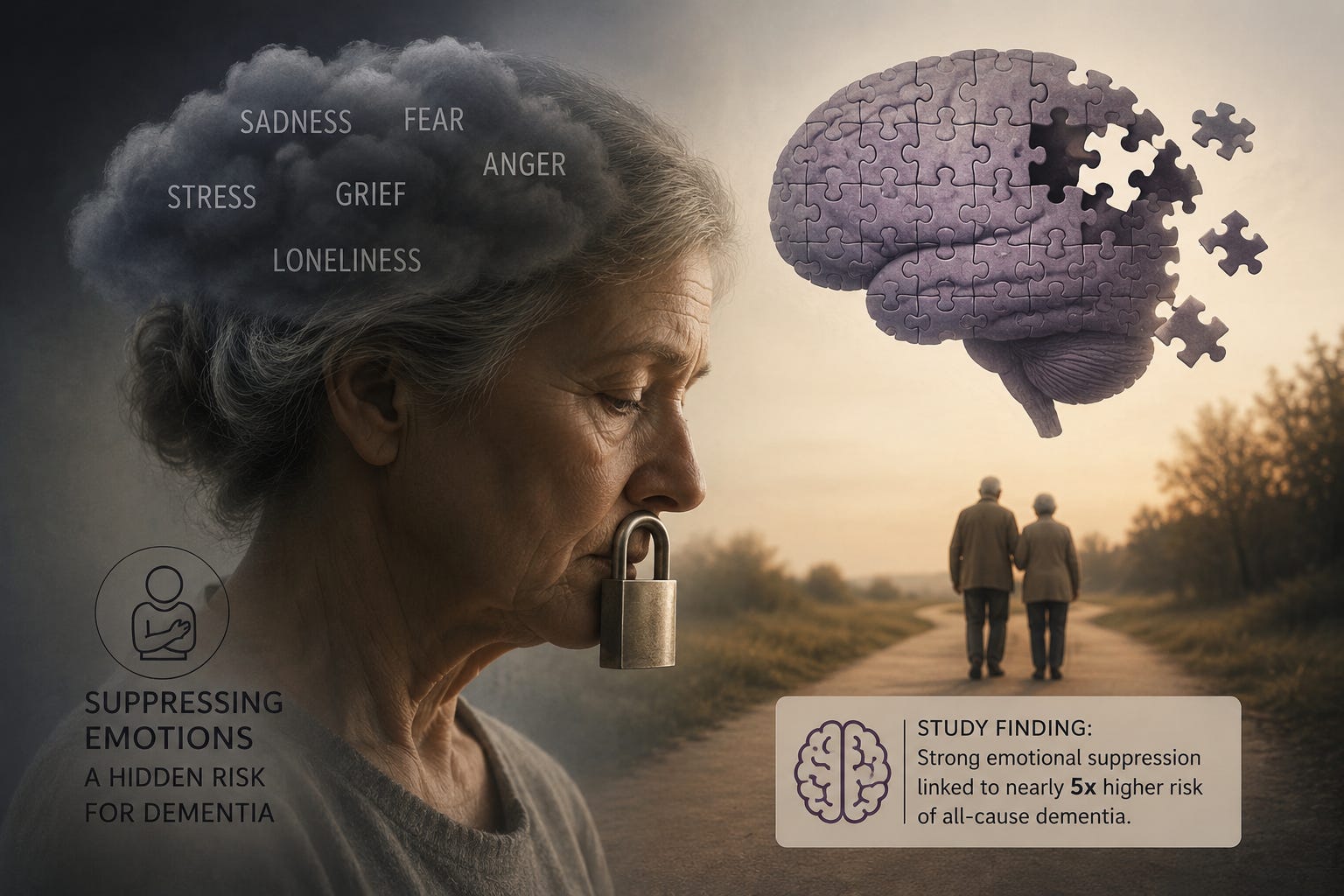
The results were striking. Individuals who strongly agreed that they suppress their emotions had nearly five times the risk of developing dementia compared to those who did not. This was not a subtle signal—it was a large and statistically significant increase in risk.
Those who reported moderate levels of emotional suppression showed a trend toward increased risk, but these findings were not statistically significant. Still, the pattern suggests something important: the more consistently emotions are suppressed, the greater the potential impact on brain health.
What This Means for the Brain
This study does not prove that emotional suppression directly causes dementia, but it does reveal a meaningful association. And when we step back and consider what we know about the brain, the connection begins to make sense.
Suppressing emotions is not a neutral act. It is a form of internal restraint that often engages stress-related systems in the brain and body. Chronic emotional suppression may be linked to prolonged activation of the stress response, including elevated cortisol levels, changes in autonomic function, and increased inflammatory signaling. Over time, these physiological shifts can influence brain regions critical for memory and cognition, including the hippocampus and prefrontal cortex.
In other words, what we do with our emotions may not stay confined to the moment. It may shape the environment in which the brain operates over years and decades.
A Broader View of Dementia Risk
Traditionally, dementia risk has been framed around factors like cardiovascular health, metabolic function, and genetics. This study expands that framework. It suggests that psychological coping styles—particularly how we handle adversity—may also play a role.
Emotional suppression often develops as a coping strategy. For some, it may feel safer to hold things in than to express them. But over time, this strategy may come with a cost. The brain is not separate from our lived experiences. It is constantly adapting to them.
Where This Leaves Us
The findings point toward an important idea: brain health is not only about what happens inside the skull—it is also about how we live, feel, and respond to the world around us.
More research is needed to understand the exact mechanisms behind this relationship. But the message is already clear enough to consider. Emotional expression, processing, and regulation are not just psychological concepts. They may be part of the biological story of aging and cognitive decline.
In a world that often rewards emotional control and composure, this research invites a different perspective. It suggests that allowing emotions to be processed—rather than consistently suppressed—may be more than just mentally healthy. It may be neurologically protective over time.
REFERENCE
Lisko I, Hall A, Håkansson K, Neuvonen E, Kulmala J, Ngandu T, Solomon A, Kivipelto M. Does suppressing one’s emotions increase the risk of all-cause dementia among older adults? Alzheimer’s & Dementia. 2020;16(Suppl 10):e043899.
interesting....
It can be channelized instead of suppressing. Like, people can channel anger by lifting weights, doing MMA, and so on. Apparently, they would feel positive emotions more if they did it.