
Flower Essences: Can the Energetic Signature of Flowers Influence Health and Emotion?
What Are Flower Essences?

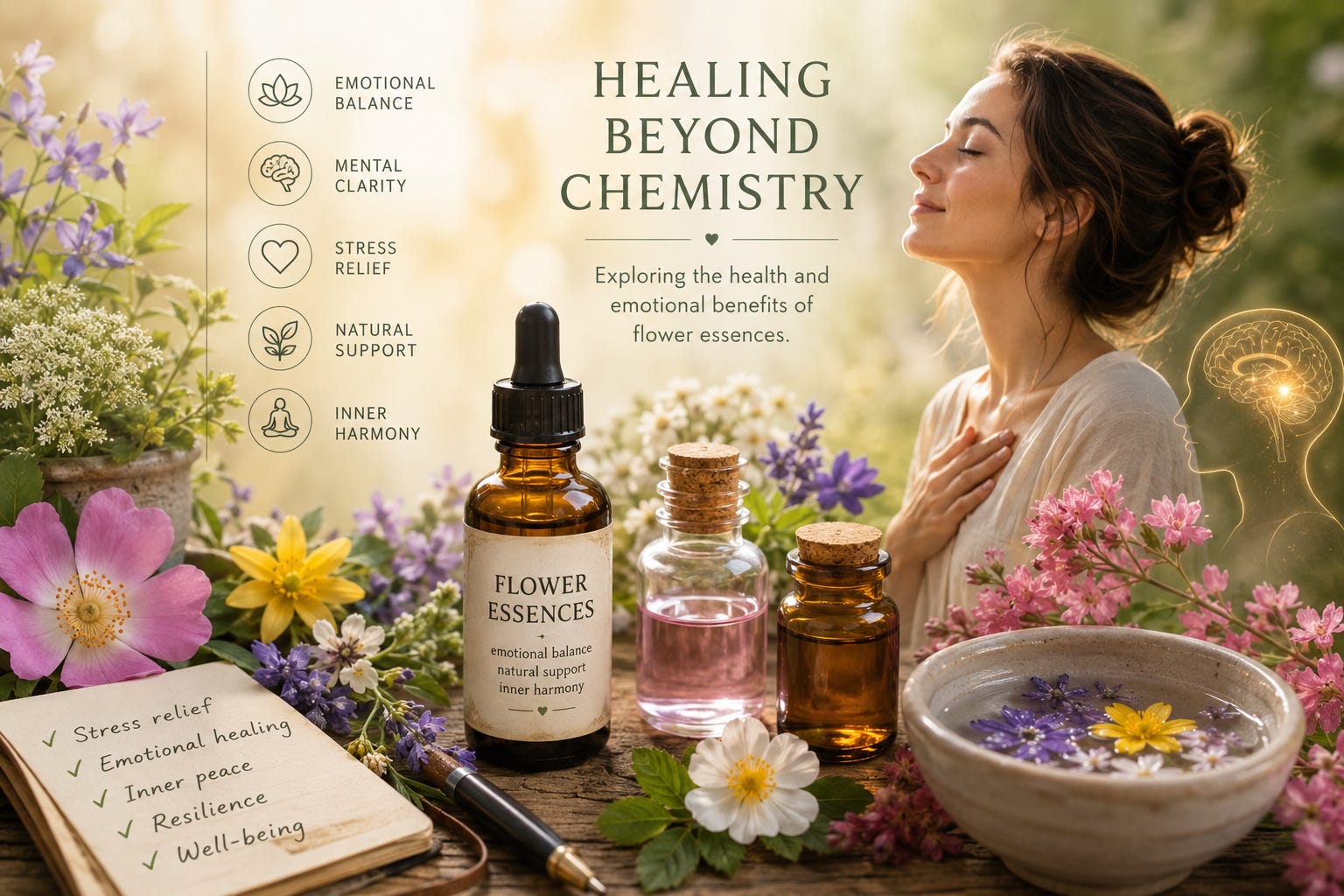
By Dr. David Traster, DC, MS, DACNB
Co-owner, The Neurologic Wellness Institute
Boca Raton • Chicago • Waukesha • Wood Dale
www.neurologicwellnessinstitute.com
Flower essences occupy a unique place at the intersection of traditional healing, psychology, spirituality, and complementary medicine. Unlike herbal medicines, essential oils, or nutritional supplements, flower essences contain little to none of the biochemical compounds found in the original plant. Instead, they are prepared by placing flowers in water and exposing them to sunlight or boiling them, with the resulting liquid preserved in alcohol. Practitioners believe that this process captures the energetic or informational signature of the flower rather than its chemical constituents.
Supporters of flower essences suggest that they work primarily on emotional, psychological, and energetic patterns rather than directly altering physiology through pharmacological mechanisms. For this reason, flower essences are often described as a form of vibrational medicine, a category that remains controversial within conventional scientific medicine.
The Origins of Flower Essence Therapy
Although flowers have been used medicinally for thousands of years, modern flower essence therapy is most closely associated with the work of British physician Edward Bach during the 1930s.
Bach was trained in conventional medicine and worked as a bacteriologist and pathologist before becoming increasingly interested in the relationship between emotions and health. He believed that emotional states such as fear, worry, resentment, uncertainty, and hopelessness could contribute to physical illness. His goal was to create a simple system that addressed emotional suffering before it manifested as disease.
Over several years, Bach identified 38 flower remedies, each corresponding to a particular emotional pattern. One of the most famous combinations became Rescue Remedy, a blend intended for periods of acute stress and emotional overwhelm.
Since Bach’s original work, hundreds of additional flower essences have been developed worldwide from plants native to North America, Australia, South America, Europe, and Asia. Today, flower essences are sold in health food stores, integrated medicine clinics, naturopathic practices, wellness centers, and online platforms throughout the world.
Flower Essences in Popular Culture
Flower essences experienced periods of increasing popularity during the holistic health movement of the 1960s and 1970s. As public interest grew in meditation, yoga, energy medicine, and mind-body healing, flower remedies became part of a broader cultural movement emphasizing emotional wellness and self-discovery.
Today, flower essences are frequently used by wellness practitioners, life coaches, naturopaths, integrative physicians, therapists, and individuals seeking non-pharmaceutical approaches to emotional health. They are commonly marketed for stress management, emotional resilience, personal growth, and spiritual development.
Social media has further amplified interest in flower essences as individuals seek natural methods to address anxiety, overwhelm, burnout, and emotional dysregulation in an increasingly stressful world.
How Are Flower Essences Supposed to Work?
The proposed mechanisms behind flower essences differ substantially from conventional medicine.
Unlike pharmaceuticals, which alter receptor activity, neurotransmitter levels, or cellular pathways, flower essences are thought to work through informational or energetic influences. Practitioners often describe them as helping to restore emotional balance by influencing subconscious patterns and emotional responses.
Some theories suggest that flower essences may act through:
Emotional conditioning pathways
Mind-body interactions
Stress regulation mechanisms
Placebo and expectancy effects
Psychophysiological self-regulation
Symbolic and meaning-based healing responses
Others propose that flowers may contain subtle energetic information that interacts with biological systems, although such theories remain difficult to test scientifically and are not widely accepted within mainstream medicine.
Potential Emotional Benefits
The most commonly reported benefits involve emotional and psychological well-being.
Users frequently report improvements in:
Stress management
Anxiety reduction
Emotional resilience
Feelings of calmness
Self-confidence
Grief processing
Fear reduction
Emotional flexibility
Sleep quality
Coping with major life transitions
Many practitioners view flower essences as tools that help individuals become more aware of emotional patterns rather than suppressing emotions. In this framework, emotional healing occurs through increased self-awareness and adaptation.
For individuals experiencing chronic stress, the ritual of taking flower essences may also promote mindfulness, reflection, and intentional self-care.
Potential Physical Health Benefits
Although flower essences are primarily intended for emotional wellness, some users report improvements in physical symptoms that may be influenced by stress physiology.
Stress has measurable effects on:
Autonomic nervous system regulation
Heart rate variability
Sleep quality
Pain perception
Immune function
Digestive function
Hormonal balance
When emotional stress decreases, secondary improvements in physical symptoms may occur. For example, reduced anxiety may improve sleep, digestion, headaches, muscle tension, and overall well-being.
However, it is important to recognize that flower essences have not been proven to directly treat diseases in the same way that medications or evidence-based medical therapies can.
What Does the Science Say?
The scientific literature on flower essences is limited and mixed.
Several small studies have investigated Bach Flower Remedies for anxiety, examination stress, attention difficulties, and emotional distress. Some studies have reported subjective improvements, while others have found no significant difference compared to placebo.
One challenge in studying flower essences is that emotional outcomes are inherently subjective and influenced by many variables, including expectation, belief, therapeutic relationships, and natural fluctuations in mood.
From a biochemical perspective, flower essences contain extremely small amounts of plant material, making it difficult to explain their effects through conventional pharmacology.
As a result, mainstream medicine generally concludes that evidence supporting flower essences remains insufficient to establish efficacy beyond placebo effects.
However, the placebo response itself should not be dismissed lightly. Modern neuroscience demonstrates that expectation, meaning, belief, ritual, and context can produce measurable changes in brain function, autonomic regulation, pain perception, and emotional experience.
The Neuroscience of Meaning and Healing
One of the most interesting scientific perspectives on flower essences comes not from plant chemistry but from neuroscience.
The human brain continuously predicts, interprets, and assigns meaning to experiences. These interpretations influence emotional states, autonomic function, immune activity, and behavior.
Research in placebo science demonstrates that belief and expectation can activate real neural circuits involving:
The prefrontal cortex
Anterior cingulate cortex
Insular cortex
Limbic system
Dopamine pathways
Endogenous opioid systems
In this sense, rituals that foster hope, calmness, and emotional reflection may have physiological consequences even if the mechanism differs from conventional pharmacology.
This does not necessarily prove flower essences possess unique energetic properties, but it highlights how powerful mind-body interactions can be.
Potential Risks and Limitations
Flower essences are generally considered low risk because they contain minimal active plant compounds.
Potential concerns include:
Delaying appropriate medical treatment
Using flower essences as a substitute for mental health care
Alcohol sensitivity from preserved preparations
Financial costs from excessive product use
Unrealistic expectations regarding serious illnesses
Individuals with severe depression, suicidal thoughts, psychosis, major anxiety disorders, or significant medical conditions should seek appropriate medical and mental health care rather than relying solely on flower essence therapies.
The safest approach is often to view flower essences as a complementary wellness practice rather than a replacement for evidence-based care.
The Larger Question: Can Information Influence Biology?
Perhaps the most fascinating aspect of flower essences is the larger philosophical question they raise.
Modern neuroscience increasingly recognizes that information influences physiology. Thoughts alter neural firing patterns. Expectations modify pain perception. Emotions influence immune activity. Social relationships affect cardiovascular health.
The debate surrounding flower essences ultimately centers on whether biological systems can respond to forms of information beyond traditional biochemical signaling.
Current scientific evidence does not provide a clear answer. Yet the question continues to intrigue researchers interested in placebo science, psychoneuroimmunology, systems biology, and the relationship between mind and body.
Final Thoughts
Flower essences remain one of the most intriguing and controversial forms of complementary medicine. Their supporters describe profound emotional and personal benefits, while critics point to a lack of convincing biochemical or clinical evidence.
What is clear is that emotions, beliefs, expectations, and meaning profoundly influence human physiology. Whether flower essences possess unique energetic properties or primarily operate through mind-body mechanisms remains an open question.
For many individuals, flower essences serve as a gentle tool for reflection, emotional awareness, and self-care. While they should not replace evidence-based medical treatment, they offer an interesting reminder that healing involves more than chemistry alone. Human health emerges from a complex interaction between biology, psychology, experience, relationships, and the stories we tell ourselves about what is possible.
REFERENCES
Ernst, E. (2010). Bach flower remedies: A systematic review of randomised clinical trials. Swiss Medical Weekly, 140(7–8), 105–110.
Thaler, K., Kaminski, A., Chapman, A., Langley, T., Gartlehner, G., & Gaynes, B. N. (2009). Bach flower remedies for psychological problems and pain: A systematic review. BMC Complementary and Alternative Medicine, 9(16), 1–8.
Bach, E. (1931). Heal thyself: An explanation of the real cause and cure of disease. London, England: C.W. Daniel Company.
Hyland, M. E., Lewith, G. T., & Westoby, C. (2006). Developing a measure of attitudes toward complementary medicine and testing its relationship with the use of flower essences and other complementary therapies. Complementary Therapies in Medicine, 14(3), 205–211.
Howard, J. (2007). The Bach flower remedies step by step: A complete guide to selecting and using the remedies. Rochester, VT: Healing Arts Press.
I enjoyed reading this.
The original teachings around making flower essences did not suggest ‘boiling’ the frequency transference in the process would not be served in the same way as sunlight infusion
Some who make flower or gem essences or other frequency essences with often note or work with the particular time of day or season; some working with moonlight infusion