
How Exercise Improves Memory: The 20-Minute Shift That Changes How the Brain Learns
New research reveals how movement directly activates the brain’s memory circuits in real time

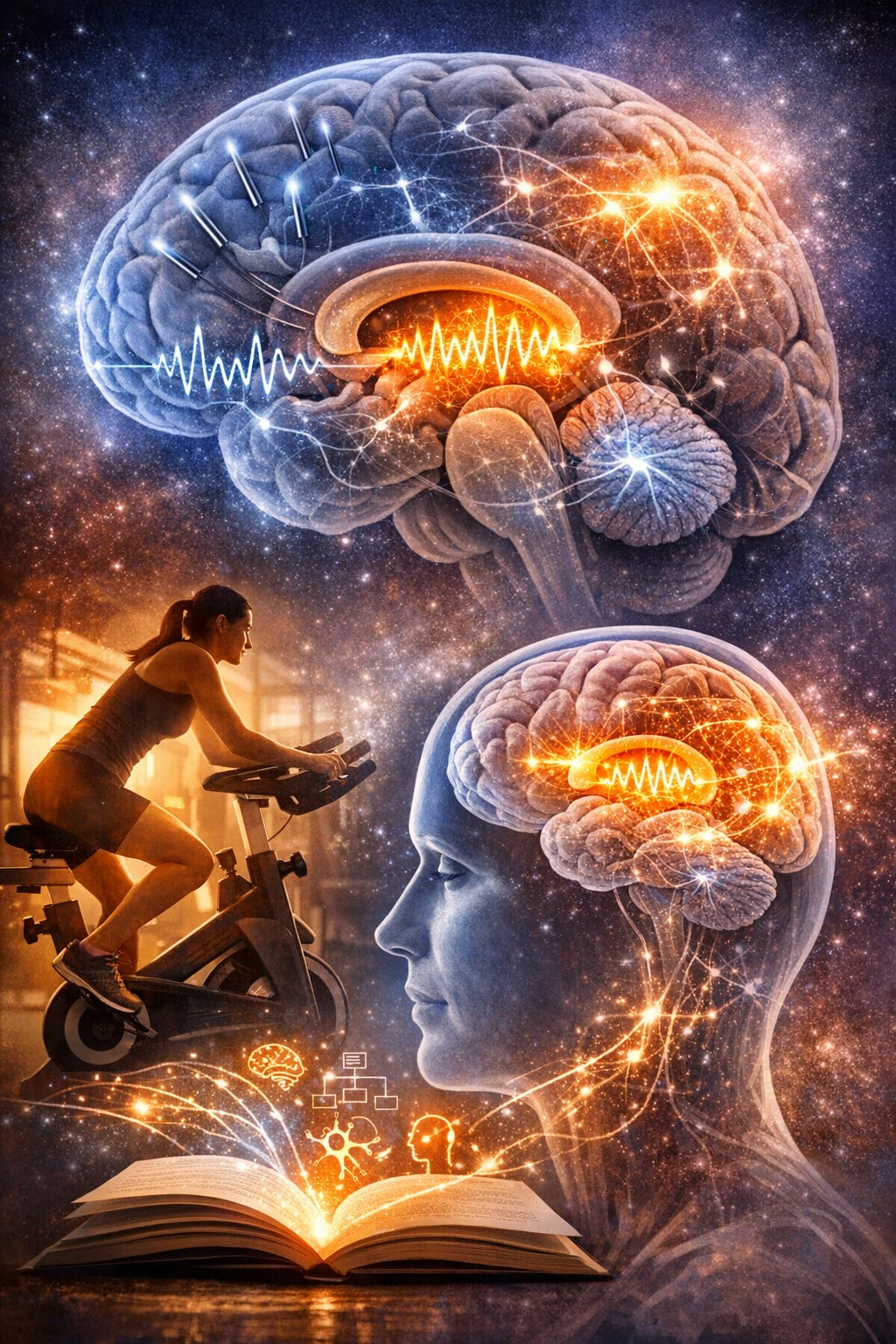
By Dr. David Traster, DC, MS, DACNB
Co-owner, The Neurologic Wellness Institute
Boca Raton • Chicago • Waukesha • Wood Dale
www.neurologicwellnessinstitute.com
Late in the day, when the clinic begins to quiet and the pace slows just enough to notice it, a familiar question often lingers in neuroscience: how does something as simple as movement change the brain so profoundly? We have long known that exercise improves memory, focus, and clarity. Patients feel it, clinicians observe it, and research supports it. But for years, we could only see the outcome—not the moment the brain itself began to change. What is now emerging is a deeper understanding: exercise does not just support the brain, it actively organizes it.
The Hidden Language of Memory
Deep within the brain, the hippocampus works quietly behind the scenes, helping transform experience into memory. It does more than store information—it organizes it. For decades, researchers studying animals observed brief bursts of electrical activity in this region known as sharp-wave ripples. These ripples are not random; they represent moments when the brain replays recent experiences, strengthening neural connections and stabilizing learning. In essence, they are the brain rehearsing what it has just encountered so it can remember it later.
A Rare Window Into the Human Brain
Until recently, this phenomenon had not been directly observed in humans at a precise level. In a unique setting, researchers were able to record brain activity using implanted electrodes, allowing them to observe real-time neural signaling. Participants performed a short bout of aerobic exercise—about twenty minutes—and researchers examined how the hippocampus responded.
What they found was striking.
The Brain Begins to Organize Itself
After exercise, the hippocampus showed a significant increase in sharp-wave ripple activity. But this was not just isolated activation—it was coordinated communication. These ripple events synchronized with activity in the cortex, the part of the brain responsible for higher-level thinking, decision-making, and awareness. This represents the moment when memory becomes usable—when raw experience begins to integrate into understanding.
Exercise increased hippocampal ripple activity (linked to memory consolidation)
Ripple activity became synchronized with cortical regions
This reflects enhanced communication between memory and higher-order processing systems
This is not just brain activity—it is the brain organizing information in real time.
Exercise as a Neural Organizer
For years, exercise has been explained through improved blood flow, oxygen delivery, and metabolic support. While all of that remains true, this research highlights something deeper: exercise changes the timing and coordination of neural networks. It enhances synchronization across brain regions, allowing information to be processed more efficiently.
Exercise does not just “activate” the brain—it organizes it
It improves timing, coordination, and communication between networks
It creates a state where learning becomes more efficient
The brain becomes not just more active, but more coherent.
The Power of a Single Session
One of the most important findings is how quickly this effect occurs. This was not a long-term training adaptation—it happened after a single session of exercise. Within minutes, the brain shifted into a state more favorable for learning and memory formation.
A single ~20-minute session triggered measurable brain changes
Effects occurred immediately, not over weeks or months
The brain entered a “primed” state for learning
This reframes exercise as an immediate cognitive tool, not just a long-term health strategy.
Priming the Brain for Learning
Consider the difference between starting a task without preparation versus beginning after movement. From the outside, the two situations may look identical. But internally, the brain is in a very different state. After exercise, the hippocampus is already active, already communicating, already preparing to encode information.
Exercise before learning may improve retention and performance
The brain becomes more adaptable and responsive
Neural circuits involved in memory are already engaged
In this way, movement becomes a gateway to more effective learning.
Clinical Implications: Timing Matters
For patients—especially those dealing with neurological challenges—this insight is powerful. It suggests that when therapy occurs may be just as important as what therapy is performed. A short bout of aerobic exercise before rehabilitation could enhance outcomes significantly.
May improve results in post-concussion and brain injury recovery
Can enhance cognitive and vestibular rehabilitation
Supports patients with memory issues or cognitive decline
May improve responsiveness in mood and stress-related conditions
The brain becomes more “teachable” when it has been activated through movement.
A Deeper, More Human Perspective
If you step back, this begins to connect with something intuitive. Humans have always used movement to change how they feel and think. Rocking soothes infants. Walking clears the mind. Spinning, dancing, and play are naturally sought out, especially by children.
This is not accidental.
Movement has always been tied to brain regulation
The body instinctively seeks input that organizes the brain
These patterns reflect deeply embedded neurological needs
The brain is not separate from movement—it depends on it.
The Takeaway
We often think of learning as something that begins when we sit still and focus. But this research suggests learning begins earlier—when the body moves and the brain prepares itself. Exercise activates the systems responsible for organizing experience into memory, allowing the brain to function more efficiently.
Exercise primes the brain for learning
It enhances memory-related neural activity
It improves communication between key brain regions
It provides an immediate and accessible tool for cognitive enhancement
In many ways, movement is not just preparation for the body.
It is preparation for the brain.
References
Derner M, et al. Exercise enhances hippocampal–cortical ripple interactions in the human brain. Brain Communications. 2026;8(2):fcag041.
Buzsáki G. Hippocampal sharp wave–ripple: A cognitive biomarker for episodic memory and planning. Hippocampus. 2015;25(10):1073–1188.
Girardeau G, Zugaro M. Hippocampal ripples and memory consolidation. Current Opinion in Neurobiology. 2011;21(3):452–459.
van Praag H, et al. Exercise enhances learning and hippocampal neurogenesis in aged mice. Journal of Neuroscience. 2005;25(38):8680–8685.
Erickson KI, et al. Exercise training increases size of hippocampus and improves memory. Proceedings of the National Academy of Sciences USA. 2011;108(7):3017–3022.
Voss MW, et al. Bridging animal and human models of exercise-induced brain plasticity. Trends in Cognitive Sciences. 2013;17(10):525–544.
Maquet P. The role of sleep in learning and memory. Science. 2001;294(5544):1048–1052.
Diekelmann S, Born J. The memory function of sleep. Nature Reviews Neuroscience. 2010;11(2):114–126.
Ratey JJ, Loehr JE. The positive impact of physical activity on cognition during adulthood. Neuroscience. 2011;2(2):171–185.
Cotman CW, Berchtold NC. Exercise: A behavioral intervention to enhance brain health and plasticity. Trends in Neurosciences. 2002;25(6):295–301.
Fascinating! Exercise isn’t just long-term investment, it’s an instant upgrade. Within minutes, the brain shifts into a state that’s ready to absorb and adapt.