

By Dr. David Traster, DC, MS, DACNB
Co-owner, The Neurologic Wellness Institute
Boca Raton • Chicago • Waukesha • Wood Dale
www.neurologicwellnessinstitute.com
Table of Contents
The Ear Is an Immune-Sensitive Organ
How Inflammation Can Become Sound
Immune Dysregulation Is More Than an Overactive Immune System
When Autoimmunity Targets Hearing
Peripheral and Central Tinnitus: Where the Problem Begins and How It Persists
The Brainstem: Where Auditory and Body Signals Meet
The Midbrain: Where Sound, Light, and Threat Responses Interact
The Thalamus and Auditory Cortex: Filtering and Interpreting Sound
Why the Same Sound Can Be Mild for One Person and Overwhelming for Another
Light Sensitivity, Anxiety, and Cognitive Dysfunction
How Infections Can Affect the Auditory System
Post-COVID Tinnitus: When an Infection Leaves an Auditory Footprint
Bacteria, Parasites, and the Importance of Context
Mold, Fungi, and Candida: Different Exposures, Different Mechanisms
Toxic Metals and Auditory Vulnerability
Other Factors That Can Increase the Burden
Why Tinnitus Can Continue After the Trigger Improves
Evaluating the Whole System
Restoring Stability to a Sensitive System
Understanding Tinnitus
Silence is not simply the absence of sound. It is something the nervous system must create. Even in a quiet room, neurons throughout the auditory system remain active. The brain must organize that activity, distinguish meaningful signals from background noise, and decide what deserves our attention. When this process changes, a person may hear ringing, buzzing, hissing, or humming without an external sound source. This is tinnitus.
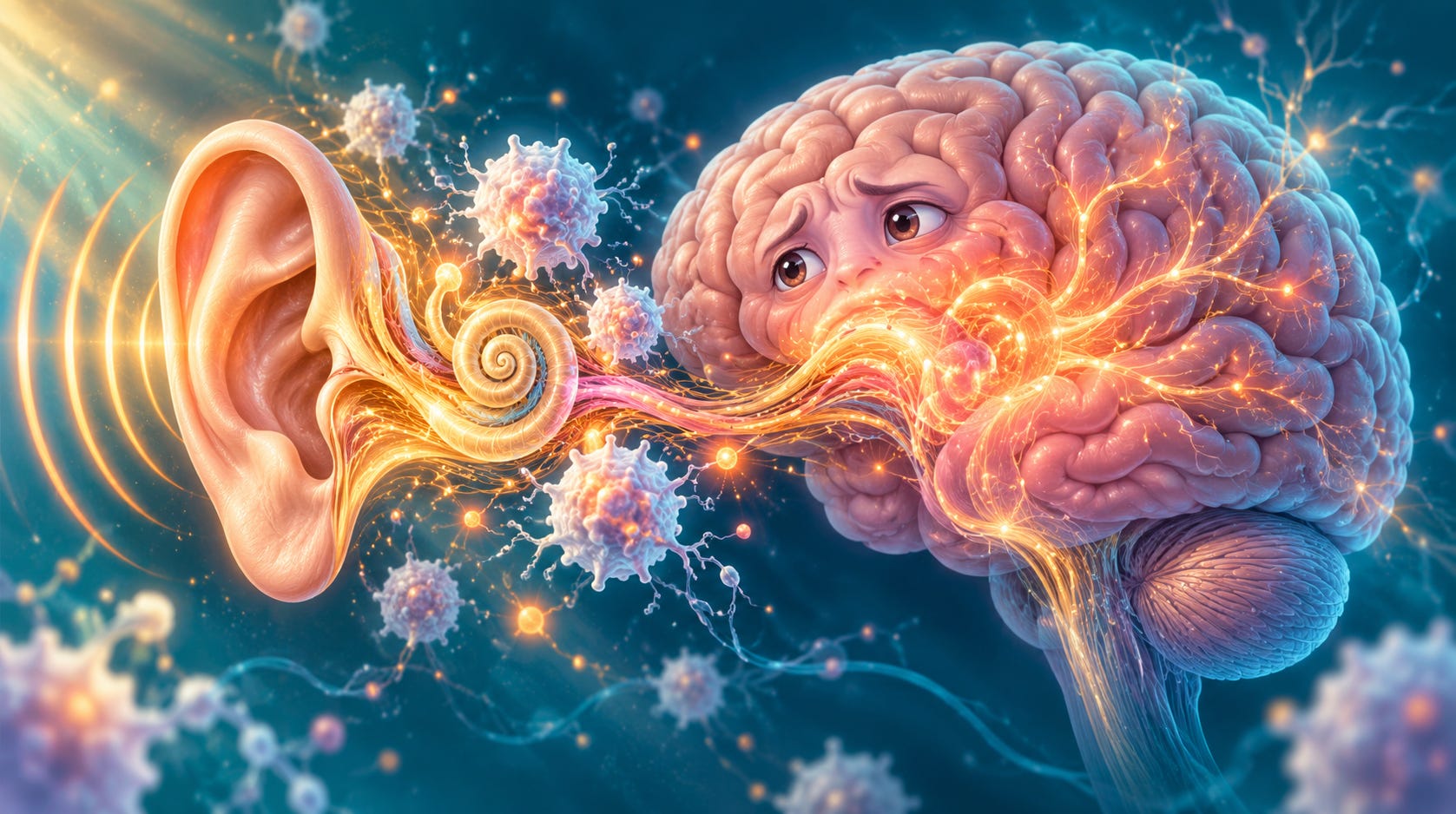
We often think of tinnitus as an ear problem. Sometimes the initial injury does occur in the ear. However, hearing is a relationship between the ear, the brain, and the physiological environment that supports both. The immune system is part of that environment. It protects tissues, responds to infection, clears damaged cells, and helps coordinate repair. Under certain conditions, those same protective processes can alter the structures and neural connections responsible for hearing.
Immune-mediated tinnitus describes tinnitus in which immune activity contributes to auditory injury or dysfunction. This can involve autoimmune disease affecting the inner ear, inflammation associated with infection, or inflammatory changes that influence how the nervous system processes sound. These possibilities do not mean that all tinnitus is an immune disorder. They mean that, in some people, understanding the sound requires looking beyond the sound itself.
The Ear Is an Immune-Sensitive Organ
The cochlea is a remarkably precise biological instrument. Within this small, fluid-filled structure, hair cells convert mechanical vibration into electrical signals. Those signals travel through the auditory nerve toward the brain. Supporting cells, specialized blood vessels, and the stria vascularis maintain the chemical and electrical conditions that make this possible.
The stria vascularis functions somewhat like the cochlea’s power supply. It helps maintain the ionic environment and electrical potential needed for hair cells to respond accurately. Changes in its function can interfere with hearing even when the problem is not a simple destruction of hair cells.
The inner ear also contains immune cells, including resident macrophages, and is protected by a specialized blood-labyrinth barrier. This barrier regulates the movement of substances between the circulation and inner-ear tissues. It offers protection, but it does not completely isolate the ear from the rest of the body.
During infection, injury, or inappropriate immune activation, inflammatory signaling can change vascular permeability, disturb fluid and ion regulation, and damage auditory structures. Hair cells, their synapses, and auditory nerve fibers may become less effective at transmitting information. The resulting change in input can provide the starting point for tinnitus.
How Inflammation Can Become Sound
Inflammation is useful when it is proportionate to the problem and resolves after its job is complete. Trouble develops when it is excessive, persistent, or directed toward healthy tissue.
Immune cells communicate through cytokines and other signaling molecules. These signals can influence blood vessels, oxidative stress, cellular metabolism, and neural transmission. In the auditory system, an inflammatory response may therefore affect both the quality of incoming information and the way neurons respond to it.
Imagine that the ear normally provides a steady, organized stream of information to the brain. If inflammation disrupts that stream, the brain may attempt to compensate by increasing its sensitivity. This process is often described as increased central gain. The nervous system effectively turns up the volume on the signals it receives, including activity that would ordinarily remain below conscious awareness.
Changes in spontaneous firing, synchronization, and the balance between excitation and inhibition can then contribute to a persistent sound percept. In experimental animal models, inflammatory signaling and microglial activation have been linked to these auditory changes. The evidence is important, but it does not establish that every person with tinnitus has brain inflammation or that suppressing inflammation will reliably eliminate the sound.
The clinically useful point is that inflammation may act as a trigger, an amplifier, or a contributor to persistence. Its role can differ substantially from one person to another.
Immune Dysregulation Is More Than an Overactive Immune System
The phrase “overactive immune system” can oversimplify the problem. Immune dysregulation may involve excessive activity in one pathway, inadequate control in another, impaired resolution of inflammation, or a response aimed at the wrong target.
A person can have difficulty controlling an infection while simultaneously experiencing excessive inflammatory signaling. Another person may develop an autoimmune response without an ongoing infection. Someone else may have recurrent allergic inflammation that affects the middle ear and hearing, without an autoimmune attack on the cochlea.
These are different biological situations. They should not be grouped together simply because tinnitus is present.
Immune balance depends on coordination among innate immune cells, T cells, B cells, regulatory mechanisms, and the tissues receiving their signals. The question is not merely whether the immune system is active. It is whether that activity is appropriate, well controlled, and able to resolve.
When Autoimmunity Targets Hearing
Autoimmunity occurs when the immune system responds inappropriately to the body’s own tissues. In autoimmune inner ear disease, immune-mediated injury can produce progressive or fluctuating sensorineural hearing loss, often involving both ears asymmetrically. Tinnitus, ear fullness, and vestibular symptoms may accompany the hearing changes.
The inner ear can also be affected as part of a systemic autoimmune condition. Diseases such as lupus, certain forms of vasculitis, rheumatoid arthritis, and other inflammatory disorders can involve auditory structures through different mechanisms. These may include inflammation of small blood vessels, impaired circulation, or immune-mediated tissue injury.
The clinical pattern matters. Tinnitus accompanied by changing hearing thresholds, recurrent vertigo, or other signs of systemic inflammatory disease raises different questions from stable tinnitus that began after years of loud-noise exposure.
There is no single blood test that conclusively identifies autoimmune tinnitus. A positive autoimmune marker does not establish that the immune system is causing the sound. Diagnosis requires the history, examination, hearing testing, and appropriate specialist evaluation to fit together.
Peripheral and Central Tinnitus: Where the Problem Begins and How It Persists
Peripheral auditory structures include the cochlea and auditory nerve. Central auditory structures include the brainstem pathways, thalamic relays, and cortical networks that process auditory information.
When clinicians describe tinnitus as having a peripheral origin, they often mean that an ear or auditory nerve problem initiated the process. Examples include noise-related injury, inflammatory cochlear damage, certain medication effects, and inner-ear disease. Hearing loss, ear fullness, or vertigo may accompany these conditions.
Central mechanisms refer to altered processing within the nervous system. Changes in neural gain, inhibition, synchronization, attention, and sensory filtering can help generate or maintain tinnitus.
However, these categories overlap. A peripheral injury can produce central adaptation, and a sound initially triggered by the cochlea can persist through changes in brain networks. Virtually all consciously perceived subjective tinnitus involves central processing, even when the initiating problem is clearly in the ear.
The distinction is therefore not a clean separation between “ear tinnitus” and “brain tinnitus.” It is a way of asking where the disturbance began, what is maintaining it, and which mechanisms are most relevant now.
A sound perceived in one ear does not prove a purely peripheral cause. A sound perceived in the middle of the head does not prove a purely central cause. Likewise, a normal standard audiogram does not establish that the cochlea is entirely normal or that the problem must be immune-mediated.
