
Molecular Hydrogen: The Smallest Molecule with Big Therapeutic Potential
What Is Molecular Hydrogen?

By Dr. David Traster, DC, MS, DACNB
Co-owner, The Neurologic Wellness Institute
Boca Raton • Chicago • Waukesha • Wood Dale
www.neurologicwellnessinstitute.com
Molecular hydrogen (H₂) is the simplest and smallest molecule in the universe—just two hydrogen atoms bonded together. It is colorless, odorless, tasteless, and non-toxic. For decades, it was considered biologically inert in humans. But over the past 15–20 years, that assumption has been overturned. Research now suggests that molecular hydrogen may act as a selective antioxidant, cellular signaling modulator, and regulator of inflammation—making it a unique and increasingly studied therapeutic agent.
Unlike most compounds used in medicine or supplementation, hydrogen is not a drug in the traditional sense. It doesn’t force a biochemical pathway. Instead, it appears to gently influence the internal environment of the body—supporting balance rather than overriding physiology.
A Brief History: From Inert Gas to Medical Interest
Hydrogen’s medical story began quietly. In the 18th and 19th centuries, hydrogen gas was explored in spa therapies and inhalation treatments, but without clear mechanistic understanding. Interest faded as modern pharmacology advanced.
The turning point came in 2007, when a landmark study demonstrated that hydrogen gas could selectively reduce highly reactive oxygen species in the brain—specifically the hydroxyl radical. This finding sparked a surge of research across neurology, cardiology, immunology, and sports medicine. Since then, thousands of studies have explored hydrogen’s potential in conditions ranging from stroke and traumatic brain injury to metabolic disease and aging.
Molecular Hydrogen vs. Hydrogen Peroxide: A Critical Distinction
It’s essential to separate molecular hydrogen (H₂) from hydrogen peroxide (H₂O₂), as they are often confused but behave very differently in biology.
Hydrogen peroxide is a reactive oxygen species. It is unstable, highly reactive, and used by the immune system as a weapon to destroy pathogens. While it plays important signaling roles in small amounts, excessive hydrogen peroxide contributes to oxidative stress, inflammation, and tissue damage.
Molecular hydrogen, on the other hand, is remarkably stable and non-reactive under most conditions. It does not indiscriminately neutralize all free radicals. Instead, it appears to selectively target the most damaging species—like hydroxyl radicals—while preserving beneficial oxidative signaling. This selectivity is one of the reasons hydrogen is so intriguing: it may reduce harm without disrupting necessary cellular communication.
The Physiology: How Does Molecular Hydrogen Work?
Hydrogen’s effects are subtle but powerful, operating at multiple levels of physiology.
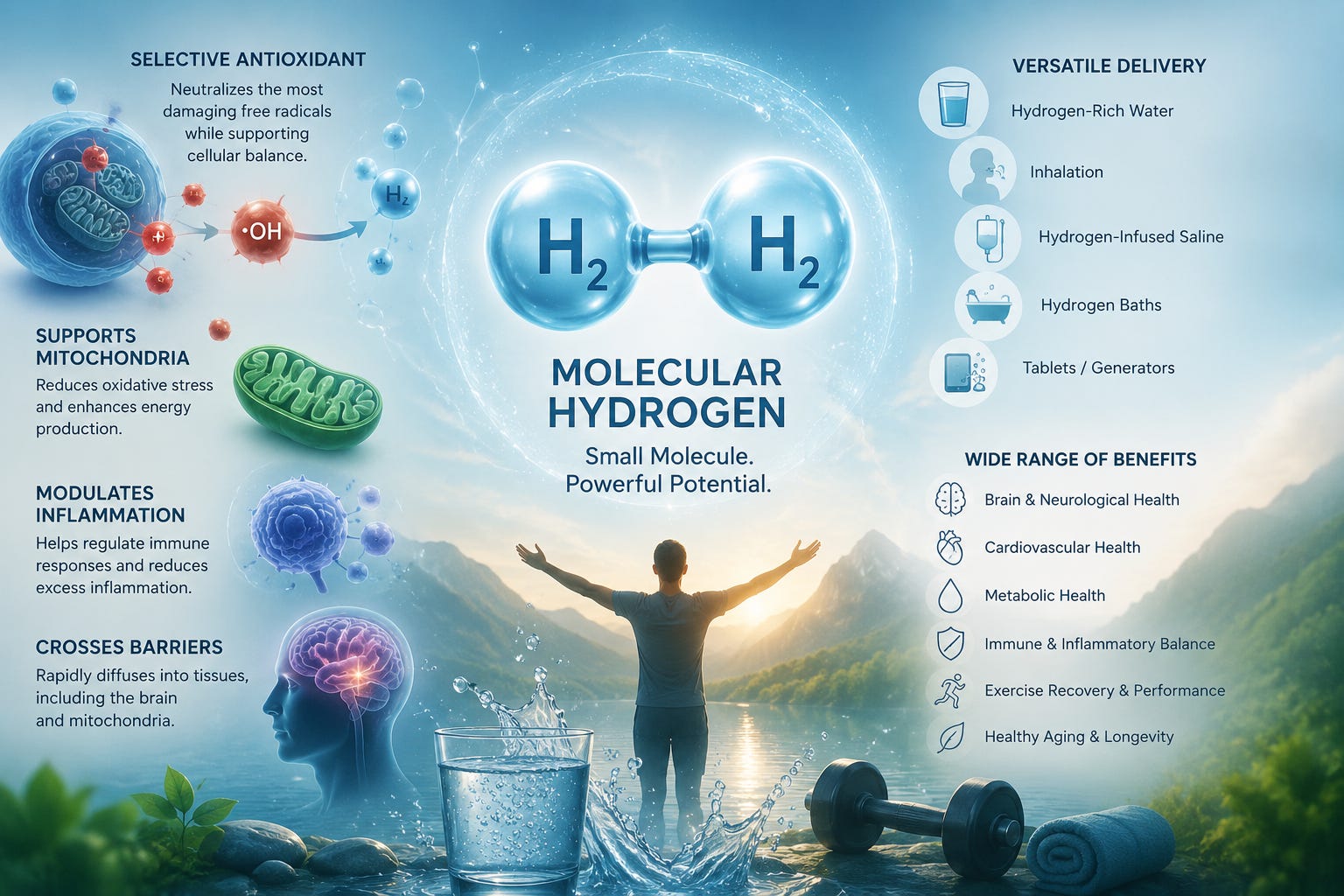
First, it acts as a selective antioxidant. Rather than flooding the system like traditional antioxidants, hydrogen diffuses rapidly into tissues—including the brain and mitochondria—where it helps neutralize the most cytotoxic reactive oxygen species. This is particularly relevant in conditions involving oxidative stress, such as neurodegeneration, chronic inflammation, and post-injury states.
Second, hydrogen appears to influence cellular signaling pathways. It modulates gene expression related to inflammation, apoptosis (cell death), and antioxidant defense systems. For example, it has been shown to activate pathways like Nrf2, which upregulates the body’s own endogenous antioxidant systems.
Third, hydrogen may improve mitochondrial function. The mitochondria are both a source and a target of oxidative stress. By reducing oxidative burden and improving redox balance, hydrogen may enhance energy production and cellular resilience.
Fourth, hydrogen interacts with the immune system. It appears to reduce excessive inflammatory signaling—particularly cytokines—while preserving immune competence. This makes it especially relevant in conditions characterized by chronic, low-grade inflammation or immune dysregulation.
Finally, hydrogen may support autonomic and vascular regulation, improving endothelial function and blood flow, which has implications for brain health, cardiovascular function, and recovery from injury.
Mechanisms of Delivery: How Can You Take Molecular Hydrogen?
One of hydrogen’s unique advantages is its flexibility in delivery. Because it is a gas, it can be administered in several ways:
Hydrogen-rich water is the most common method. Hydrogen gas is dissolved into water and consumed orally. This is simple, accessible, and widely used for both therapeutic and general wellness purposes.
Inhalation therapy involves breathing hydrogen gas, often mixed with oxygen. This allows for rapid systemic absorption and is commonly used in clinical or research settings.
Hydrogen-infused saline is used in some medical environments, delivered intravenously to achieve higher concentrations.
Hydrogen baths allow transdermal absorption, where hydrogen dissolves into bathwater and diffuses through the skin.
Hydrogen tablets or generators are also widely available, producing hydrogen gas when dissolved in water.
Each method has different pharmacokinetics, but all leverage hydrogen’s ability to rapidly diffuse across membranes and reach tissues that many compounds cannot easily access.
Safety Profile: How Safe Is Molecular Hydrogen?
One of the most compelling aspects of molecular hydrogen is its safety. It is naturally produced by bacteria in the human gut and has been consumed in small amounts throughout human history via certain foods and fermentation processes.
At therapeutic levels, hydrogen has shown an excellent safety profile in both animal and human studies. It does not appear to accumulate in the body, and excess hydrogen is simply exhaled through the lungs.
Even at relatively high concentrations, hydrogen has not demonstrated toxicity. The primary safety consideration is related to flammability at very high concentrations in enclosed spaces, which is why medical-grade delivery systems are carefully controlled.
From a clinical perspective, hydrogen is one of the few interventions that appears to have minimal downside risk with potentially broad upside benefit.
Clinical Applications: What Conditions Might It Help?
Research on molecular hydrogen spans a wide range of conditions, many of which share common underlying mechanisms: oxidative stress, inflammation, and mitochondrial dysfunction.
In neurology, hydrogen has been studied in stroke, traumatic brain injury, Parkinson’s disease, Alzheimer’s disease, and multiple sclerosis. Its ability to cross the blood-brain barrier and modulate neuroinflammation makes it particularly compelling.
In cardiovascular health, hydrogen may improve endothelial function, reduce oxidative damage, and support recovery after ischemic events.
In metabolic conditions, including diabetes and metabolic syndrome, hydrogen has shown potential to improve insulin sensitivity and reduce inflammatory markers.
In autoimmune and inflammatory disorders, hydrogen may help regulate immune responses and reduce cytokine-driven inflammation.
In gastrointestinal health, hydrogen may support mucosal integrity and reduce inflammation in conditions like IBS and IBD.
In sports medicine and recovery, hydrogen has been shown to reduce muscle fatigue, improve recovery, and decrease exercise-induced oxidative stress.
Optimization and Performance: Beyond Disease
Perhaps one of the most exciting areas of hydrogen research is its role in optimization rather than just treatment.
For healthy individuals, hydrogen may support:
Improved energy production through mitochondrial efficiency
Faster recovery from physical and cognitive stress
Reduced baseline inflammation
Enhanced resilience to environmental stressors
Improved sleep and autonomic balance
In a world where many interventions push the body harder, hydrogen appears to do something different—it may help the body recover, adapt, and regulate more effectively.
The Future of Molecular Hydrogen
Molecular hydrogen sits at an interesting intersection between medicine, wellness, and fundamental physiology. It is not a traditional pharmaceutical, yet its effects may rival or complement many existing therapies.
The challenge moving forward is not whether hydrogen has biological effects—it clearly does—but how to best harness those effects in a precise, personalized, and evidence-based way.
As research continues, hydrogen may become a foundational tool in both clinical care and human performance—quietly influencing the internal environment in a way that allows the body to do what it was designed to do: heal, adapt, and function at a higher level.
REFERENCES
Ohsawa I, Ishikawa M, Takahashi K, et al. Hydrogen acts as a therapeutic antioxidant by selectively reducing cytotoxic oxygen radicals. Nat Med. 2007;13(6):688–694.
Ohta S. Molecular hydrogen as a preventive and therapeutic medical gas: initiation, development and potential of hydrogen medicine. Pharmacol Ther. 2014;144(1):1–11.
Ohta S. Molecular hydrogen is a novel antioxidant to efficiently reduce oxidative stress with potential for the improvement of mitochondrial diseases. Biochim Biophys Acta. 2012;1820(5):586–594.
Ichihara M, Sobue S, Ito M, et al. Beneficial biological effects and the underlying mechanisms of molecular hydrogen—comprehensive review of 321 original articles. Med Gas Res. 2015;5:12.
Nicolson GL, de Mattos GF, Settineri R, et al. Clinical effects of hydrogen administration: from animal and human diseases to exercise medicine. Int J Clin Med. 2016;7(1):32–76.
LeBaron TW, Laher I, Kura B, Slezak J. Hydrogen gas: from clinical medicine to an emerging ergogenic molecule for sports athletes. Can J Physiol Pharmacol. 2019;97(9):797–807.
Ge L, Yang M, Yang NN, Yin XX, Song WG. Molecular hydrogen: a preventive and therapeutic medical gas for various diseases. Oncotarget. 2017;8(60):102653–102673.
Dole M, Wilson FR, Fife WP. Hyperbaric hydrogen therapy: a possible treatment for cancer. Science. 1975;190(4210):152–154.
Kajiyama S, Hasegawa G, Asano M, et al. Supplementation of hydrogen-rich water improves lipid and glucose metabolism in patients with type 2 diabetes or impaired glucose tolerance. Nutr Res. 2008;28(3):137–143.
Ostojic SM. Molecular hydrogen in sports medicine: new therapeutic perspectives. Int J Sports Med. 2015;36(4):273–279.
As someone living with CRPS, this caught my attention immediately—not because I see molecular hydrogen as a “cure,” but because many of the systems being discussed here overlap with mechanisms increasingly being explored in CRPS research.
Oxidative stress.
Neuroinflammation.
Mitochondrial strain.
Autonomic dysregulation.
Circulatory and endothelial changes.
These are all areas many people with CRPS experience in very real ways.
What I find especially interesting is the idea of supporting the body’s regulation systems rather than simply suppressing symptoms. The discussion around selective antioxidant activity, mitochondrial support, inflammatory signaling, and vascular function feels highly relevant to the broader physiology many chronic pain patients are trying to better understand.
I appreciate seeing emerging science framed with curiosity and mechanism rather than exaggerated promises.
For many of us living with complex chronic conditions, understanding why the body may be struggling matters deeply. Sometimes even understanding the physiology changes the experience itself. Thank you 💕
Oops my apologies my dog bumped my arm, just when I wanted to post a Thank you❣️🫶🏼❣️🙏🏼👍🏼💪🏼👊🏼✌🏼🫶🏼🥰🥰🥰Any & all important health information like this is always sincerely appreciated by me & I am quite positive I will not the only one who does❣️🫶🏼❣️🥹🙏🏼🥰🥰🥰