
Strength Training for the Nervous System: The Forgotten Organ of Brain Health
Muscle is not just for movement—it is one of the brain’s primary regulators

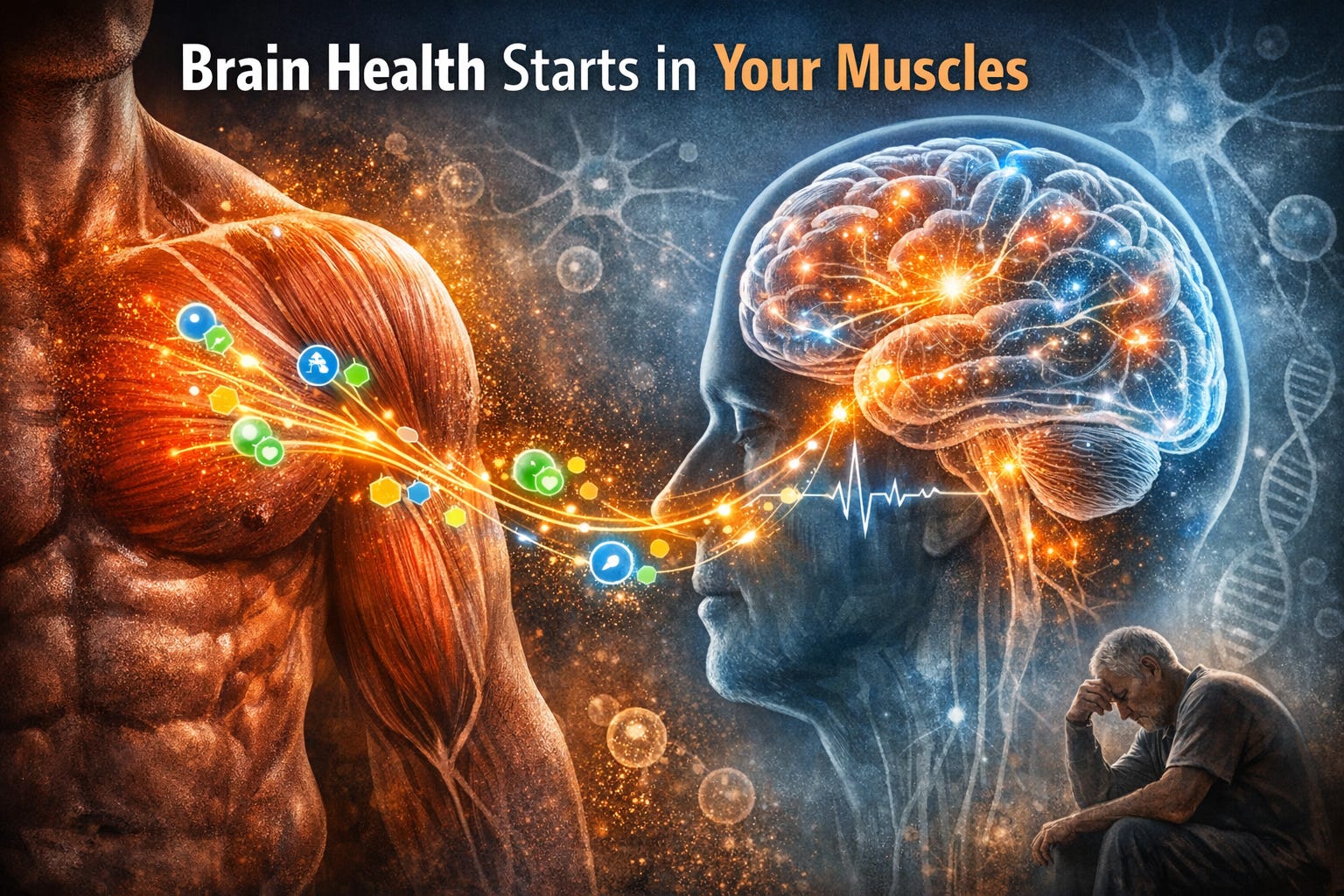
By Dr. David Traster, DC, MS, DACNB
Co-owner, The Neurologic Wellness Institute
Boca Raton • Chicago • Waukesha • Wood Dale
Most people think brain health lives in the head.
They think of neurons, neurotransmitters, blood flow, inflammation, plaques, tangles, and maybe genetics. They think of puzzles, memory games, supplements, sleep, meditation. All important. All incomplete.
Because one of the most powerful regulators of brain health doesn’t live in the skull at all.
It lives in your muscles.
Not metaphorically. Literally.
Skeletal muscle is not just tissue that moves bones. It is an endocrine organ—one that speaks to the brain constantly, chemically, electrically, metabolically. And with every decade of life, that conversation either strengthens…or fades.
Aging is not just a story of neurons wearing out.
It is a story of muscles going silent.
And when muscles go quiet, the brain listens.
Muscle Is a Signaling Organ, Not Just a Motor
For decades, muscle was treated as machinery: levers, force production, strength, endurance. But modern physiology has overturned that view.
Active muscle releases signaling molecules—often called myokines—directly into circulation. These molecules do not stay local. They travel.
They reach:
• the brain
• the immune system
• blood vessels
• the liver
• fat tissue
• even other muscles
This means every time muscle contracts with purpose, it sends biochemical information upstream to the brain.
When muscle is trained, nourished, and metabolically alive, it sends supportive signals.
When muscle atrophies, inflames, or becomes insulin-resistant, it sends stress signals.
The brain does not exist outside this loop. It is embedded within it.
The Hidden Cost of Muscle Loss With Age
Age-related muscle loss—often dismissed as “normal aging”—is anything but benign.
As muscle mass declines:
• baseline inflammation rises
• glucose regulation worsens
• vascular health deteriorates
• mitochondrial efficiency drops
• neurotrophic signaling diminishes
But here is the critical point:
Muscle loss does not just reduce strength.
It reduces brain input.
Fewer muscle fibers mean fewer contraction-triggered signals. Fewer signals mean less neurotrophic support. Less support means the brain becomes more vulnerable—to cognitive decline, mood disorders, balance problems, and neurodegenerative processes.
This is not coincidence. It is systems biology.
Exercise Is Not Movement—It Is Messaging
When we talk about exercise, we often reduce it to calories burned or muscles toned. That framing misses the real story.
Exercise is communication.
Each contraction releases a cascade of molecular messages that cross the blood–brain barrier or influence it indirectly through vascular, immune, and metabolic pathways.
Some of the most important categories include:
• neurotrophic signals that support neuron survival and plasticity
• angiogenic signals that improve cerebral blood flow
• anti-inflammatory signals that calm overactive immune pathways
• metabolic signals that stabilize energy supply to neurons
The brain interprets these signals as safety, capacity, and adaptability.
And brains that receive those messages consistently age very differently than brains that do not.
Key Pathways From Muscle to Brain
1. Neurotrophic Support
Active muscle stimulates the release of molecules that encourage brain plasticity—supporting learning, memory, and repair. These signals promote synaptic resilience and help the brain adapt rather than rigidify with age.
This is one reason exercise consistently outperforms cognitive training alone for long-term brain health.
The brain needs challenge—but it also needs biological permission to adapt.
Muscle provides that permission.
2. Vascular and Blood Flow Regulation
The brain is an energy-hungry organ. It depends on precise blood flow regulation.
Muscle activity improves:
• endothelial function
• nitric oxide signaling
• cerebral perfusion
• oxygen delivery
This is not abstract. Improved gait, posture, and strength directly influence cardiovascular dynamics that feed the brain.
Balance problems, dizziness, and cognitive fog often improve not because the brain was “trained,” but because the body restored the flow environment the brain depends on.
3. Inflammation and Immune Calibration
Aging brains often suffer less from neuron loss and more from immune dysregulation.
Chronic low-grade inflammation alters neural signaling, disrupts autonomic balance, and sensitizes pain and threat circuits.
Exercise-activated muscle releases anti-inflammatory signals that:
• reduce systemic cytokine load
• improve immune resolution
• stabilize the blood–brain barrier
In other words, muscle helps teach the immune system when to stand down.
A calmer immune system is a calmer brain.
4. Metabolic Stability and Energy Signaling
Neurons do not tolerate energy instability well.
Muscle improves insulin sensitivity, glucose handling, and mitochondrial efficiency—creating a more stable metabolic environment for the brain.
This matters for:
• cognitive endurance
• emotional regulation
• sleep architecture
• autonomic balance
Many “brain symptoms” improve when the brain stops having to compensate for metabolic chaos elsewhere in the body.
Why Muscle Mass Matters More Than You Were Told
Strength is not just about lifting heavier objects. Muscle mass is a reservoir of metabolic flexibility and signaling capacity.
More muscle means:
• more myokine output
• better glucose buffering
• stronger anti-inflammatory tone
• greater resilience during illness or stress
Loss of muscle is not cosmetic. It is neurological.
This is why resistance training matters—not for aesthetics, but for preserving the body-to-brain conversation.
And why gentle, progressive loading often outperforms passive therapies for long-term neurological stability.
The Aging Brain Is Still Plastic—If the Body Gives It a Reason
One of the most damaging myths of aging is inevitability.
Yes, change occurs. But decline is not pre-written.
Brains remain plastic far longer than we once believed. What they require is consistent, meaningful input.
Muscle provides some of the most biologically convincing input the brain can receive.
Not extreme.
Not punishing.
Not reckless.
But regular, intentional movement that challenges tissue just enough to signal growth instead of threat.
This Is Why Exercise Is Medicine—But Only When Prescribed Correctly
Exercise works not because it “burns calories,” but because it restores communication between systems that evolved to function together.
The brain expects the body to move.
The immune system expects muscle contraction.
The vascular system expects rhythmic load.
The nervous system expects feedback.
When those expectations are met, regulation returns.
When they are ignored, compensation begins—and compensation is exhausting for the brain.
The Takeaway
You cannot separate brain health from muscle health.
You cannot talk about aging without talking about contraction.
You cannot talk about cognition without talking about circulation.
You cannot talk about neuroplasticity without talking about movement.
Muscle is not optional tissue.
It is a signaling organ that tells the brain whether the world is safe, demanding, or declining.
And as we age, the message we send matters more than ever.
Train the muscle.
Support the signal.
Protect the brain.
Because the body and brain are not two systems.
They are one conversation.
References
Pedersen, B. K., & Febbraio, M. A. (2012). Muscles, exercise and obesity: Skeletal muscle as a secretory organ. Nature Reviews Endocrinology, 8(8), 457–465.
Erickson, K. I., Hillman, C. H., & Kramer, A. F. (2015). Physical activity, brain, and cognition. Current Opinion in Behavioral Sciences, 4, 27–32.
Cotman, C. W., Berchtold, N. C., & Christie, L. A. (2007). Exercise builds brain health. Trends in Neurosciences, 30(9), 464–472.
Handschin, C., & Spiegelman, B. M. (2008). The role of exercise and PGC1α in inflammation and chronic disease. Nature, 454(7203), 463–469.
Booth, F. W., Roberts, C. K., & Laye, M. J. (2012). Lack of exercise is a major cause of chronic diseases. Comprehensive Physiology, 2(2), 1143–1211.
Gomez-Pinilla, F., & Hillman, C. (2013). The influence of exercise on cognitive abilities. Comprehensive Physiology, 3(1), 403–428.
Seals, D. R., & Jablonski, K. L. (2019). Aging, muscle, and vascular function. Journal of Applied Physiology, 126(6), 1634–1642.
Piccirillo, R. (2019). Exercise-induced myokines with therapeutic potential. Molecular Metabolism, 25, 1–12.
Phillips, S. M., & McLeod, M. (2011). Resistance training and aging muscle. Applied Physiology, Nutrition, and Metabolism, 36(5), 706–713.
Voss, M. W., Nagamatsu, L. S., Liu-Ambrose, T., & Kramer, A. F. (2011). Exercise, brain, and cognition across the lifespan. Journal of Applied Physiology, 111(5), 1505–1513.
Very clear and concise article! Thank you for posting this. I'd like to emphasise on this: Exercise works not because it “burns calories,” but because it restores communication between systems that evolved to function together.
Unfortunately, there is still the belief that exercise is just to burn the 350 calorie donut you just ate; reality is more nuanced, human metabolism is complex and different for each person; and burning calories it's not just the only thing exercise does. Again, I recommend people take some time to read this. Strength training is necessary for our brain!
Really appreciate the whole myokines angle here, kinda shifts how you think bout strength work. The "muscles going silent" metaphor is powerful stuff, cuz it frames sarcopenia not just as weakness but as literal loss of biochemical comunication. Though i wonder if theres a minimum threshold effect or if even minimal load triggers sum signaling? Been noticing better mental clarity on lifting days myself, now this makes more sense why.