
Part 1: The Glymphatic Norepinephrine Connection: How Sleep Cleans the Brain and Tunes the Body
Uncovering the hidden neurochemical rhythms that drive the brain’s nightly cleanup

By Dr. David Traster, DC, MS, DACNB
Co-owner, The Neurologic Wellness Institute
Boca Raton • Chicago • Waukesha • Wood Dale
Most people treat sleep like a light switch.
One moment you’re awake — flooded with thoughts, cortisol, coffee, scrolling, deadlines, gravity pulling on your spine, noise hammering your senses — the next moment you’re asleep. A blank screen. A pause button.
But inside your skull, sleep is anything but a pause.
It is a tide. A pump. A cleaning crew. A pressure recalibration. A vascular waltz choreographed by one of the most misunderstood conductors in neurology:
Norepinephrine.
Not adrenaline’s loud cousin that gets credit for panic attacks and powerlifting PRs.
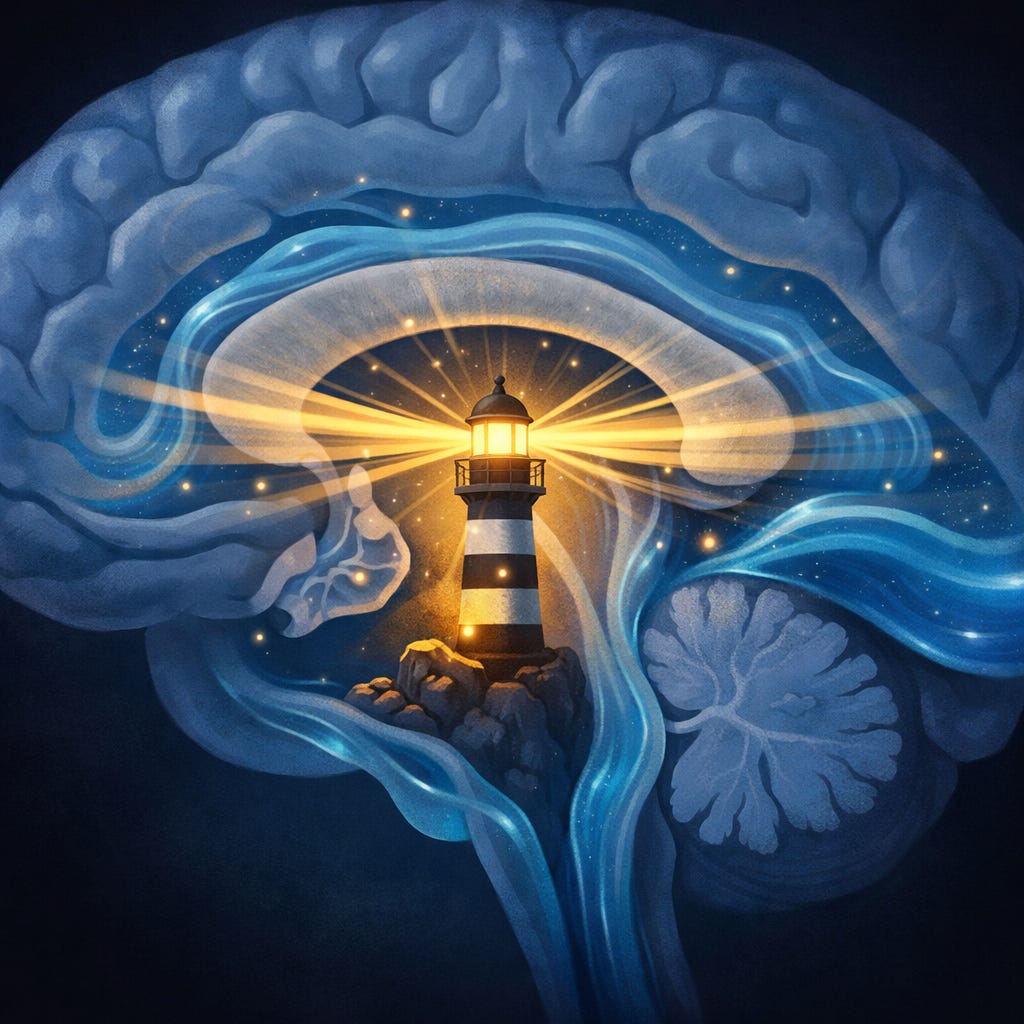
But its quieter, rhythmic counterpart — released deep in the brainstem, from a nucleus no bigger than a cashew, the locus coeruleus — that pulses through the night like a lighthouse beacon signaling the brain’s drainage system when to flow, when to flush, when to clear.
This is the part of sleep no one talks about at dinner parties. Yet it may be the most important biological event you experience every 24 hours.
Because while you’re dreaming about falling (or not falling), your brain is moving fluid.
The Discovery That Changed the Story
In 2024, researchers publishing in Cell uncovered something remarkable:
During deep non-REM sleep, norepinephrine is not off. It is oscillating.
It releases in slow rhythmic pulses, which cause equally slow rhythmic contractions and expansions in cerebral blood vessels — a process called vasomotion.
Think of it as a pump, not driven by the heart, but by neurochemistry.
With each pulse:
Cerebral blood volume gently rises and falls
Cerebrospinal fluid surges forward in response
Fluid is pushed through brain tissue like water through a sponge
Metabolic waste is carried away in the current
This synchronized movement between blood and CSF is the engine behind the glymphatic system — the brain’s internal plumbing — a network of channels that clears out the debris of wakefulness:
Misfolded proteins, inflammatory by-products, metabolites your neurons don’t want hanging around, and most notably, the villains of cognitive aging:
Amyloid-β and tau.
These are the same proteins that, when allowed to accumulate, are associated with neurodegenerative conditions like Alzheimer’s disease.
Suddenly, sleep wasn’t just rest.
It was maintenance.
Physical, hydraulic, rhythmic, chemically timed maintenance.
Brain + Body: A System, Not a Metaphor
What makes this discovery so powerful isn’t just that the brain cleans itself at night — we already suspected that.
It’s how tightly integrated the process is with the body.
Norepinephrine is both:
a neurotransmitter, shaping alertness, vascular tone, proprioceptive gain, motor readiness, and autonomic modulation
and a hormone, influencing systemic blood pressure, circulation, stress response, and energy allocation
During sleep, it acts as the liaison between neural command centers and the vascular system, orchestrating a rhythm that:
supports brain detoxification
stabilizes cerebral pressure dynamics
helps balance autonomic flexibility
and contributes to overall immune quieting and metabolic resetting
Sleep is not something the brain does for the body.
It is something the brain does with the body.
A negotiation between:
pressure sensors in arteries
neurochemical pacemakers in the brainstem
fluid currents around neurons
and the posture and physiology that determine how all of it drains
When Sedation Is Not Sleep
The researchers then tested what happens when we interfere.
They looked at zolpidem, one of the most prescribed sleep medications in the world.
The result?
It suppressed the very norepinephrine oscillations that drive vasomotion.
The patient falls asleep faster, yes — but the pump slows down.
Glymphatic flow decreases. The sponge isn’t squeezed. The nightly tide weakens.
Which leads to a question that feels ripped from the pages of your book:
If you knock someone out, but you silence the cleaning crew, did they really sleep?
Or did they just lose consciousness while their brain’s plumbing stalled?
The Cost of Not Reaching Deep Sleep
Now zoom out from the brainstem lighthouse and into real life:
A person who does not reach sustained non-REM sleep, or whose sleep architecture is repeatedly disrupted by:
inflammation
chronic pain
migraine networks stuck in high-gain
vestibular circuits in sensory over-compensation
autonomic collapse
stimulants too late in the day
or sedatives that chemically flatten the tide
…may be missing the window where the brain cleans itself most efficiently.
And that has ripple effects:
morning headaches
foggy cognition
amplified pain
poor motor coordination
blood pressure instability
increased inflammatory signaling
reduced recovery capacity
and potentially, increased long-term neurological risk
Sleep debt isn’t just fatigue.
It is drainage debt.
So What Supports the Nightly Tide?
For patients and readers trying to decode their own neurological mystery, the implications are clear:
Foundational Supports
Consistent sleep schedule
Reaching deep non-REM sleep
Minimizing sleep fragmentation
Supporting vascular health and autonomic flexibility
Reducing inflammatory load before bedtime
Avoiding stimulants too late in the day
Being cautious with sedatives that suppress brainstem neurochemical rhythms
Systemic Impacts
Good sleep supports:
Immune resolution (inflammation decreases, cytokine noise quiets)
Metabolic reset (improved insulin sensitivity, energy partitioning)
Cerebral pressure regulation
Neurovascular tone balancing
Motor + sensory recalibration
Brain detoxification via glymphatic clearance
Autonomic resilience
Brain Targets
This process specifically benefits:
Cerebellar prediction networks
Brainstem autonomic centers
Vascular pressure sensors
Cranial nerve modulation hubs
Multisensory integration pathways
CSF circulation dynamics
Sleep Is Treatment, Even When No One Prescribes It
In your clinics, you’ve been saying a version of this for years in patient language:
“We don’t treat dizziness, we treat the brain that’s struggling to stabilize.”
This paper adds another line to that story:
We don’t just need sleep — we need the type of sleep where the brainstem pulses, the vessels pump, the fluid drains, and the brain cleans itself.
Because every night, your nervous system is asking the same question:
Can we clear what we no longer need so we can adapt tomorrow?
If the answer is yes, the tide flows.
If the answer is no, symptoms accumulate, compensation increases, inflammation whispers louder, and the mystery deepens.
And if there’s one thing your book teaches us, it’s this:
The mystery is solvable.
Sometimes, the first clue is simply found in the night.
References
Xie, L., Kang, H., Xu, Q., et al. (2013). Sleep drives metabolite clearance from the adult brain. Science, 342(6156), 373–377.
Iliff, J. J., Wang, M., Liao, Y., et al. (2012). A paravascular pathway facilitates CSF flow through the brain parenchyma and the clearance of interstitial solutes, including amyloid β. Science Translational Medicine, 4(147), 147ra111.
Taoka, T., & Naganawa, S. (2020). Glymphatic imaging using MRI. Journal of Magnetic Resonance Imaging, 51(1), 11–24.
Benveniste, H., Nedergaard, M., & Lee, H. (2019). The Glymphatic System and Waste Clearance with Brain Aging: A Review. Gerontology, 65(2), 106–119.
Holth, J. K., Fritschi, S. K., Wang, C., et al. (2019). The sleep-wake cycle regulates brain interstitial fluid tau in mice and CSF tau in humans. Science, 363(6429), 880–884.
Ishibashi, M., Feldman, M. D., Shui, Y.-B., et al. (2015). Cerebrospinal fluid absorption predominantly via lymphatic pathways in healthy and aging rats. Fluids and Barriers of the CNS, 12, 24.
Louveau, A., Smirnov, I., Keyes, T. J., et al. (2015). Structural and functional features of central nervous system lymphatic vessels. Nature, 523(7560), 337–341.
Hablitz, L. M., Vinitsky, H. S., Sun, Q., et al. (2019). Increased glymphatic influx is correlated with high EEG delta power and low heart rate in mice under anesthesia. Science Advances, 5(2), eaav5447.
Fultz, N. E., Bonmassar, G., Setsompop, K., et al. (2019). Coupled electrophysiological, hemodynamic, and cerebrospinal fluid oscillations in human sleep. Science, 366(6465), 628–631.
Xie, L. (2021). Mechanisms of glymphatic clearance and their role in neurological disease. Nature Reviews Neurology, 17(7), 414–425.
This is such a strong (and clinically relevant) reframing: the glymphatic system isn’t just a “sleep benefit,” it’s a state-dependent maintenance program and norepinephrine is one of the key switches.
What’s especially compelling from a neurobiology standpoint is the nuance you highlight: during wakefulness, higher noradrenergic tone helps us stay alert and efficient, but it also “tightens the system”. Then in deep NREM sleep, norepinephrine shifts into slower rhythmic pulses that appear to coordinate vasomotion, CSF influx, and interstitial clearance. In other words, the brain doesn’t simply power down at night; it changes operating mode to run a rinse cycle.
Clinically, that helps explain why anything that fragments deep sleep or keeps sympathetic tone high (sleep apnea, late alcohol, late meals, chronic stress, certain sedatives, bright light late at night) can show up as morning brain fog, headaches, and lower resilience over time.
Sleep quality isn’t a luxury, but it’s neuroprotective infrastructure!
Thank you for reminding us of the importance of the “Driano “ effect!
Those of us who are unable to initiate sleep are presented with a dilemma. To sleep or to take out the garbage?
Zolpidem has enabled 5 hours of sleep after the stroke.
I imagine there is Not a sleep aid that does not disturb the norepinephrine-glymphatic connection. Homeostasis in later life is a rare commodity. Thank you once again.