
Understanding How the Brain Keeps You Upright: Multisensory Integration, Sensory Weighting, and Balance Testing
How Vision, Proprioception, and the Vestibular System Work Together to Keep You Upright

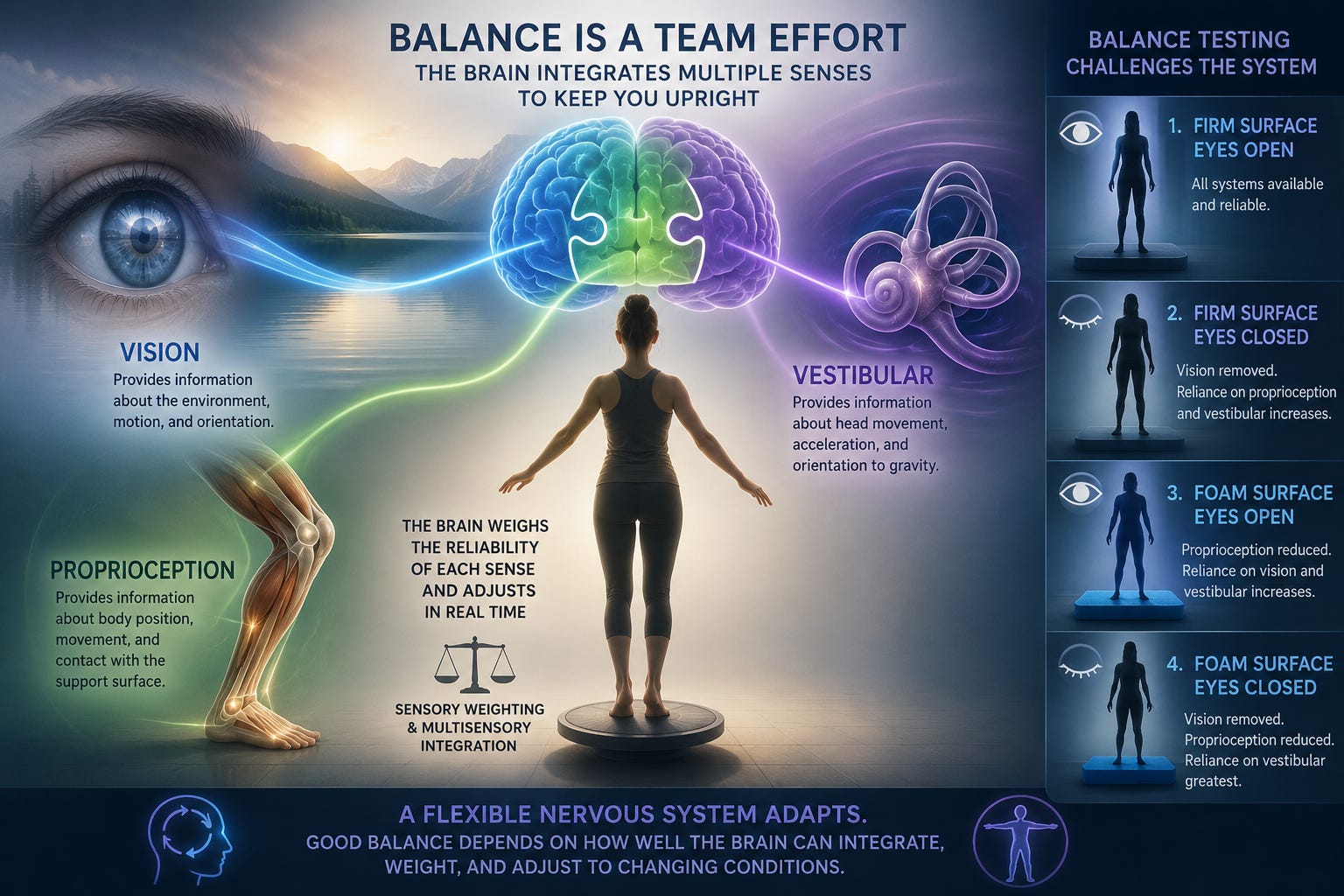
By Dr. David Traster, DC, MS, DACNB
Co-owner, The Neurologic Wellness Institute
Boca Raton • Chicago • Waukesha • Wood Dale
www.neurologicwellnessinstitute.com
Balance Is a Brain Function
Most people think balance is primarily a function of the inner ear. While the vestibular system is critically important, balance is actually the product of a complex process known as multisensory integration. Every second of every day, the brain receives information from multiple sensory systems and determines which sources of information are most reliable. It then combines, prioritizes, suppresses, or enhances those signals to create a stable perception of body position and movement.
Standing upright is one of the most computationally demanding tasks performed by the nervous system. The brain must continuously determine where the body is in space, how fast it is moving, whether it is stable or unstable, and whether corrective actions are needed to prevent a fall. To accomplish this, the nervous system relies primarily on three major sensory systems: vision, proprioception, and the vestibular system.
The way the brain combines and prioritizes these sensory signals is known as sensory weighting.
The Three Major Sensory Systems for Balance
Vision provides information about the external environment. It helps determine motion, orientation, distance, and the relationship between the body and surrounding objects. Visual cues often dominate balance perception because they provide a rich source of spatial information.
Proprioception provides information from muscles, joints, ligaments, and skin receptors regarding body position and movement. Mechanoreceptors in the feet, ankles, knees, hips, spine, and neck constantly inform the brain about the body’s position relative to the support surface.
The vestibular system provides information regarding head movement, acceleration, and orientation relative to gravity. Unlike vision and proprioception, vestibular information is largely independent of the external environment and remains reliable even in darkness.
Under normal circumstances, the brain continuously integrates information from all three systems to maintain postural stability.
What Is Sensory Weighting?
Sensory weighting refers to the brain’s ability to determine how much importance should be assigned to each sensory input at any given moment. The nervous system does not treat all sensory information equally. Instead, it constantly evaluates which sensory source appears most reliable and adjusts its weighting accordingly.
Imagine standing on a firm floor with your eyes open. Visual information is reliable. Proprioceptive information from your feet and legs is reliable. Vestibular information is reliable. All three systems contribute significantly to balance.
Now imagine standing on a moving dock. Proprioceptive information from the feet becomes less reliable because the support surface is moving. The brain must decrease its reliance on proprioception and increase its dependence on vision and vestibular input.
Now imagine standing in complete darkness on a moving boat. Visual information disappears entirely. Proprioceptive information is distorted. The vestibular system suddenly becomes the most important source of information.
The ability to dynamically shift between sensory systems is one of the hallmarks of a healthy nervous system.
When Sensory Weighting Fails
Many neurological disorders involve abnormalities in sensory weighting rather than damage to a single sensory system. In these situations, the brain may over-rely on one sensory system while under-utilizing another.
Some individuals become excessively dependent on vision. Others may rely too heavily on proprioceptive feedback. Some may fail to properly integrate vestibular information. When this occurs, patients often experience symptoms such as dizziness, imbalance, motion sensitivity, visual dependence, disorientation in busy environments, difficulty walking on uneven surfaces, or feelings of instability when visual information is removed.
The sensory systems themselves may be functioning relatively normally. The problem lies in how the brain processes and prioritizes their information.
Visual Dominance and Visual Dependence
One of the most common findings in patients with dizziness and balance disorders is visual dominance. Visual dominance occurs when the nervous system becomes excessively reliant on visual information to maintain postural stability. These individuals often perform reasonably well when visual cues are available but deteriorate significantly when visual information is reduced or removed.
Patients with visual dependence frequently report worsening symptoms in:
Crowded stores
Busy traffic
Scrolling on phones
Virtual reality environments
Moving visual scenes
Airports
Shopping malls
Large open spaces
The nervous system begins treating vision as the primary source of truth even when visual information becomes misleading or inaccurate. As a result, moving visual environments can create a false sensation of body motion, leading to dizziness, instability, and anxiety.
Why Eyes-Closed Testing Matters
One of the simplest ways to evaluate sensory weighting is through eyes-open and eyes-closed balance testing. When the eyes are open, all three sensory systems contribute to postural control. When the eyes are closed, visual input is removed. The nervous system must now rely more heavily on proprioceptive and vestibular information.
If balance deteriorates dramatically when the eyes are closed, this suggests excessive visual dependence or impaired proprioceptive and vestibular processing. Many patients are surprised to discover how much they depend on vision until it is removed.
The difference between eyes-open and eyes-closed performance often reveals valuable information about sensory weighting strategies.
The Importance of Firm and Perturbed Surfaces
Removing vision is only one way to challenge the balance system. Changing the support surface creates an entirely different sensory challenge.
When standing on a firm surface, proprioceptive information from the feet and ankles is highly accurate. When standing on foam, a balance pad, unstable platform, or moving surface, proprioceptive information becomes less reliable.
The brain must now shift weighting away from proprioception and increase reliance on vestibular and visual information. This allows clinicians to evaluate how effectively the nervous system adapts when sensory conditions change.
The Four Classic Balance Conditions
A simple sensory-weighting assessment can be performed using four conditions.
Firm Surface, Eyes Open
This is the easiest condition. Vision, proprioception, and vestibular information are all available and reliable. Most healthy individuals perform well under this condition.
Firm Surface, Eyes Closed
Vision is removed. The brain must rely primarily on proprioceptive and vestibular input. Significant deterioration may indicate visual dependence or impaired proprioceptive and vestibular processing.
Foam Surface, Eyes Open
Proprioceptive reliability is reduced. The nervous system must increase reliance on visual and vestibular information. Difficulty here may indicate problems adapting to changing sensory conditions.
Foam Surface, Eyes Closed
This is often the most challenging condition. Vision is absent. Proprioceptive information is distorted. The vestibular system becomes the primary source of information. Failure in this condition frequently suggests vestibular dysfunction or impaired multisensory integration.
What the Brain Is Actually Doing
During these tests, the brain is not simply trying to stay upright. It is constantly comparing incoming sensory information and evaluating whether the signals agree with one another. If vision says one thing, proprioception says another, and vestibular information says something different, the brain must determine which system is most trustworthy.
This process occurs across a distributed network that includes the vestibular nuclei, cerebellum, thalamus, posterior parietal cortex, insular cortex, temporoparietal junction, basal ganglia, and frontal cortical regions. Balance emerges from the coordinated activity of these networks rather than from any single brain region.
Clinical Implications
Abnormal sensory weighting can be found in a wide range of conditions including vestibular disorders, concussion, traumatic brain injury, PPPD, vestibular migraine, dysautonomia, aging, stroke, Parkinson’s disease, multiple sclerosis, functional neurological disorders, cerebellar dysfunction, and chronic dizziness syndromes.
Understanding how an individual weights sensory information provides important insight into the underlying neurological mechanisms contributing to their symptoms. Rather than simply asking whether someone can balance, clinicians can determine how they balance and which sensory systems they rely upon most heavily.
This information can then guide targeted rehabilitation strategies designed to improve multisensory integration and restore more normal sensory weighting patterns.
The Goal of Rehabilitation
The goal of balance rehabilitation is not simply to improve strength or coordination. The goal is to improve the brain’s ability to accurately integrate sensory information and dynamically shift weighting between visual, proprioceptive, and vestibular inputs as environmental demands change.
A healthy nervous system is flexible. It can rapidly adapt when sensory conditions change. It can trust vision when vision is reliable, trust proprioception when the support surface is stable, and trust the vestibular system when other sensory inputs become unavailable.
The ability to appropriately reweight sensory information is one of the defining characteristics of efficient balance control and healthy neurological function.
References
Horak, F. B. (2006). Postural orientation and equilibrium: What do we need to know about neural control of balance to prevent falls? Age and Ageing, 35(Suppl. 2), ii7–ii11.
Horak, F. B., & Macpherson, J. M. (2011). Postural orientation and equilibrium. In L. H. Rowell & J. T. Shepherd (Eds.), Handbook of Physiology: Exercise Regulation and Integration of Multiple Systems (pp. 255–292). Oxford University Press.
Peterka, R. J. (2002). Sensorimotor integration in human postural control. Journal of Neurophysiology, 88(3), 1097–1118.
Peterka, R. J., & Loughlin, P. J. (2004). Dynamic regulation of sensorimotor integration in human postural control. Journal of Neurophysiology, 91(1), 410–423.
Nashner, L. M. (1976). Adapting reflexes controlling the human posture. Experimental Brain Research, 26(1), 59–72.
Shumway-Cook, A., & Woollacott, M. H. (2017). Motor control: Translating research into clinical practice (5th ed.). Wolters Kluwer.
Bronstein, A. M. (2016). Multisensory integration in balance control. In A. M. Bronstein (Ed.), Oxford Textbook of Vertigo and Imbalance (pp. 73–84). Oxford University Press.
Brandt, T., Dieterich, M., & Strupp, M. (2013). Vertigo and dizziness: Common complaints (2nd ed.). Springer.
Cullen, K. E. (2019). Vestibular processing during natural self-motion: Implications for perception and action. Nature Reviews Neuroscience, 20(6), 346–363.
Mergner, T., & Rosemeier, T. (1998). Interaction of vestibular, somatosensory, and visual signals for postural control and motion perception under terrestrial and microgravity conditions. Brain Research Reviews, 28(1–2), 118–135.
Thank you, Dr. Traster. This was one of the clearest explanations I've read of how the brain integrates vestibular, visual, and proprioceptive information to maintain balance.
As someone experiencing intermittent lightheadedness, often associated with bloating and gastrointestinal discomfort, your article helped me think about balance as a multisensory process rather than just an inner ear problem.
I have a question: from a neuroplasticity perspective, what are the most effective daily habits or exercises for improving vestibular function and multisensory integration in people with mild chronic dizziness? Is simple walking combined with balance and gaze stabilization training enough, or are there other evidence-based approaches you recommend?
Thank you for sharing your expertise.
Okay, I wasn't expecting to get a deep dive into the hidden truths behind balance disorders. Nonetheless, I'm grateful for this little 101. Being a biology major helped me track some of the terminology in this. Mentioning that a healthy nervous system is flexible, anchors the entire piece. It’s so fascinating seeing that balance is not just a static physical trait, but a highly distributed network spanning the cerebellum, cortex, and vestibular nuclei. This info serves as the perfect roadmap for how we isolate sensory error and force neuroplastic adaptation. The brain is so intelligent and fascinating. I've been doing deep dives moreso in to cognitive functions and wired traits and have come to the realization that everything works like a network. I wish you'd talk more about this in your upcoming posts. Thanks!