
Velocity Storage: The Brain’s Internal Compass for Motion, Gravity, and Dizziness
Why Some People Continue to Feel Motion After Movement Stops

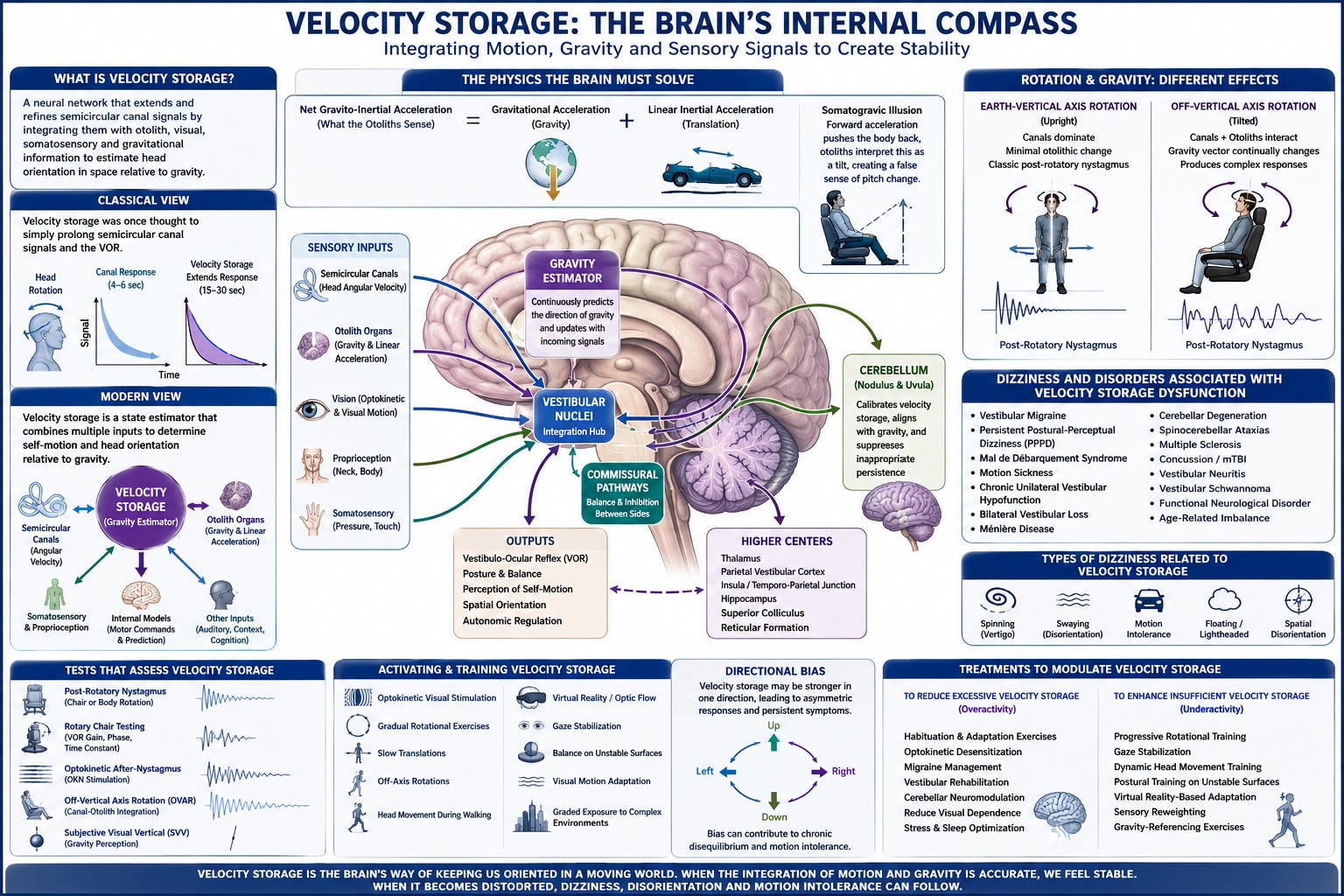
By Dr. David Traster, DC, MS, DACNB
Co-owner, The Neurologic Wellness Institute
Boca Raton • Chicago • Waukesha • Wood Dale
www.neurologicwellnessinstitute.com
One of the greatest mysteries in vestibular neuroscience is why two people can experience the exact same movement yet one immediately feels stable while the other continues to feel as though they are spinning, swaying, floating, or being pulled long after the movement has ended. The answer often lies within one of the brain’s most remarkable computational systems known as velocity storage.
Velocity storage is not simply a mechanism that prolongs the vestibulo-ocular reflex (VOR), as it was once believed. Modern neuroscience has transformed our understanding of this system. Rather than serving only as a temporal integrator of semicircular canal signals, velocity storage is now recognized as a sophisticated neural network that continuously integrates information from the semicircular canals, otolith organs, visual motion pathways, and gravitational signals to determine how the head is moving through three-dimensional space relative to gravity.
This system constantly asks one essential question: “Which direction is down?” Every movement of the head must be interpreted relative to gravity before the brain can determine whether the body is rotating, translating, falling, tilting, or remaining stable. When this computation becomes distorted, dizziness often follows.
The Classical View of Velocity Storage
The semicircular canals are exquisitely sensitive to angular acceleration. When the head begins rotating, endolymph within the canals lags behind due to inertia, bending the cupula and stimulating hair cells. This mechanical response, however, is surprisingly brief. The physical time constant of the canals is only about 4–6 seconds. If the canals alone determined our perception of motion, the sensation of spinning would disappear almost immediately after rotation began.
Yet anyone who has spun rapidly in a chair knows this is not what happens. The sensation of rotation persists for considerably longer, often 15–30 seconds, and the eyes continue producing post-rotatory nystagmus long after the mechanical response of the canals has faded.
This discrepancy led neuroscientists to propose the existence of a central “velocity storage integrator.” Rather than allowing canal signals to disappear rapidly, neurons within the vestibular nuclei continue recycling this information, effectively extending the duration of the VOR and prolonging the perception of motion. For decades this temporal extension was believed to be the primary function of velocity storage.
Although correct, this explanation represented only a fraction of the system’s true purpose.
The Modern View: A Gravity Referencing Network
Today, velocity storage is understood as one of the brain’s primary mechanisms for constructing an internal estimate of orientation relative to gravity. Instead of merely storing rotational velocity, the system combines multiple sensory inputs to continuously estimate body orientation within Earth’s gravitational field.
These sensory inputs include:
Head angular velocity detected by the semicircular canals
Gravitational acceleration detected by the otolith organs
Linear inertial acceleration during translation
Visual motion detected through optokinetic pathways
Cervical proprioception
Somatosensory information from the body
Internal predictive motor commands
The brain must constantly determine whether acceleration detected by the otoliths represents actual translation, head tilt relative to gravity, or some combination of both.
This problem is extraordinarily difficult because the otolith organs cannot distinguish gravity from linear acceleration. Both produce identical forces upon the otolithic membrane according to Einstein’s equivalence principle. Velocity storage helps solve this ambiguity.
Head Angular Velocity
The semicircular canals measure rotational movement. They detect angular acceleration in three dimensions:
Pitch
Roll
Yaw
After these signals enter the vestibular nuclei, velocity storage prolongs and refines this information, allowing the nervous system to estimate rotational velocity beyond the short mechanical response of the canals themselves. Without this extension, stable gaze during prolonged movement would be impossible.
Gravitational Acceleration
Gravity constantly accelerates the body toward Earth’s center at approximately 9.81 meters per second squared. Unlike angular acceleration, gravity never turns off. The otolith organs continuously monitor this gravitational vector. The brain uses this information as a permanent spatial reference frame against which all head movements are interpreted.
Linear Inertial Acceleration
Whenever we accelerate in a car, elevator, airplane, or train, the otolith organs detect these linear accelerations. Unfortunately, the otoliths cannot determine whether this force came from gravity or from actual movement. This creates one of the largest computational challenges faced by the vestibular system. Velocity storage helps separate these competing possibilities by incorporating information from the semicircular canals and prior estimates of body orientation.
Net Gravito-Inertial Acceleration
The force reaching the otoliths is actually the combination of two separate vectors:
Gravity
plus
Linear acceleration
This combined signal is known as the net gravito-inertial acceleration.
The nervous system must continuously estimate how much of this force represents gravity and how much represents translation. This computation occurs continuously every second of every day.
Somatogravic Feedback
Pilots have long recognized one dangerous consequence of this computational challenge. Rapid forward acceleration pushes the body backward into the seat, causing the otoliths to interpret this force as if the head were tilting upward. The pilot may incorrectly perceive the aircraft climbing and push the nose downward despite level flight.
This illusion is known as the somatogravic illusion. Velocity storage participates in correcting these errors by integrating canal information with gravitational estimates over time. When this integration becomes inaccurate, spatial disorientation develops.
The Velocity Storage Integrator
Rather than acting as a simple timer, the velocity storage integrator continuously updates estimates of body orientation relative to gravity.
Its functions include:
Extending rotational signals
Stabilizing gaze
Updating orientation estimates
Aligning eye movements with Earth’s vertical
Integrating canal and otolith information
Reducing sensory ambiguity
Improving long-duration motion perception
Modern computational models increasingly describe this network as a dynamic state estimator rather than a passive storage mechanism.
The Gravity Estimator
Closely linked to velocity storage is what researchers often describe as the gravity estimator. This internal model continuously predicts where gravity should be acting. Every new vestibular signal is compared with this prediction. If incoming sensory information differs from expectation, the estimate is updated. This allows the nervous system to maintain stable orientation despite continuous movement. Failure of this estimator contributes to many chronic dizziness disorders.
Earth-Vertical Rotation Versus Off-Vertical Rotation
Velocity storage behaves differently depending upon how the body rotates relative to gravity. During Earth-vertical axis rotation, the body rotates around a vertical axis while remaining upright. The semicircular canals dominate the response, producing prolonged post-rotatory nystagmus with relatively little otolithic influence.
Off-vertical axis rotation is far more complex. As the body rotates while tilted relative to gravity, the otolith organs become continuously stimulated because the direction of gravity changes relative to the head throughout the rotation. This continuously changing otolithic input repeatedly updates velocity storage.
The resulting responses differ dramatically from upright rotation and provide valuable information about how canal and otolith signals converge. These paradigms have become essential research tools for understanding vestibular integration.
Canal-Otolith Convergence
One of the greatest advances in vestibular neuroscience has been recognition that canal and otolith information are deeply intertwined. The canals detect rotational motion. The otoliths detect gravity and translation. Velocity storage combines both signals into a unified estimate of self-motion.
This convergence explains why patients with selective otolith dysfunction often experience abnormalities in motion perception despite relatively normal canal testing. Likewise, patients with cerebellar lesions frequently demonstrate impaired integration of both systems.
Directional Bias Within Velocity Storage
Velocity storage is not always perfectly balanced. Many individuals develop directional preferences. Some respond excessively to rightward rotations. Others demonstrate stronger responses during leftward motion. Similarly, upward and downward pitch rotations may be processed differently.
Directional bias can contribute to:
Persistent postural asymmetry
Chronic disequilibrium
Motion intolerance
Vestibular migraine
Mal de Débarquement syndrome
Functional dizziness
Spatial disorientation
These asymmetries likely arise from differences in vestibular nuclei activity, cerebellar modulation, commissural inhibition, or long-term adaptive plasticity.
Head Orientation in Space
Perhaps the most important function of velocity storage is maintaining an accurate estimate of head orientation relative to Earth. Every head movement changes the relationship between the canals, otoliths, and gravity. The nervous system must continuously update its internal estimate of orientation.
Without this computation:
Eye movements become unstable.
Balance deteriorates.
Motion perception becomes inaccurate.
Spatial navigation declines.
Patients often describe feeling detached from space itself.
The Neural Circuitry of Velocity Storage
Velocity storage emerges from a distributed network rather than a single anatomical location. The vestibular nuclei serve as the primary computational hub where canal, otolith, visual, and proprioceptive information first converge. Commissural pathways between the bilateral vestibular nuclei help balance vestibular tone and create symmetry between the two sides. The cerebellar nodulus and uvula provide powerful inhibitory control over velocity storage. These regions help align vestibular signals with gravity, suppress inappropriate persistence of rotational signals, and recalibrate the internal estimate of Earth vertical.
Additional contributions arise from the fastigial nucleus, inferior olive, nucleus prepositus hypoglossi, interstitial nucleus of Cajal, vestibular thalamus, parietal vestibular cortex, temporo-parietal junction, insula, hippocampus, superior colliculus, and brainstem reticular formation. Together these regions link motion perception, gaze stabilization, posture, autonomic regulation, spatial memory, and conscious perception of orientation.
Rather than functioning as isolated structures, these networks continuously exchange information to produce a unified sense of self-motion.
Clinical Disorders Associated With Velocity Storage Dysfunction
Growing evidence implicates abnormal velocity storage in numerous neurological conditions.
These include:
Persistent Postural-Perceptual Dizziness (PPPD)
Vestibular migraine
Mal de Débarquement syndrome
Motion sickness
Chronic unilateral vestibular hypofunction
Bilateral vestibular loss
Vestibular neuritis
Ménière disease
Cerebellar degeneration
Spinocerebellar ataxias
Multiple sclerosis
Concussion
Mild traumatic brain injury
Vestibular schwannoma
Functional neurological disorders
Age-related imbalance
Many patients with these disorders demonstrate abnormal persistence of nystagmus, altered motion perception, impaired adaptation to gravity, or distorted estimates of head orientation in space.
Testing Velocity Storage
Velocity storage cannot be measured directly, but its behavior can be inferred through specialized vestibular testing. Post-rotatory nystagmus remains one of the classic assessments. After rapid chair rotation, the duration and decay of nystagmus reflect the time constant of velocity storage. Prolonged responses suggest an increased time constant, while unusually brief responses may indicate impaired storage.
Rotary chair testing can quantify vestibulo-ocular reflex gain, phase, and time constants across multiple frequencies, providing insight into central vestibular processing.
Optokinetic stimulation offers another window into the system. Sustained movement of a full-field visual scene activates optokinetic pathways that converge upon velocity storage. When the visual stimulus stops, optokinetic after-nystagmus reflects the interaction between visual motion processing and the velocity storage network.
Off-vertical axis rotation (OVAR) is particularly valuable because it repeatedly changes the relationship between the head and gravity, challenging canal-otolith integration and the brain’s gravity estimator.
Additional experimental approaches include slow translational movements, prolonged rotational paradigms, subjective visual vertical testing, visual dependence assessments, computerized dynamic posturography, motion perception thresholds, dynamic visual acuity testing, and laboratory-based gravito-inertial paradigms.
Each provides unique insight into how effectively the nervous system integrates motion with gravity.
Activating and Training Velocity Storage
Because velocity storage is highly plastic, it can be intentionally challenged and retrained.
Optokinetic visual stimulation exposes patients to controlled visual motion that engages both visual motion pathways and vestibular integration.
Gradual rotational exercises progressively increase tolerance to angular movement.
Slow translational movements challenge otolith processing while minimizing excessive canal stimulation.
Off-axis rotations require continuous recalibration of gravity estimates.
Head movement during walking forces integration of vestibular, visual, cervical, and proprioceptive information.
Virtual reality environments allow controlled manipulation of optic flow and gravitational references.
Visual motion adaptation, gaze stabilization exercises, balance tasks performed on unstable surfaces, and graded exposure to complex sensory environments all encourage recalibration of velocity storage while promoting more accurate multisensory integration.
Modulating Velocity Storage in Clinical Practice
Treatment should always be individualized because velocity storage may be excessively active in some disorders and insufficient in others.
Patients with vestibular migraine, motion sickness, or Mal de Débarquement syndrome often appear to benefit from strategies that reduce excessive persistence of motion signals. These may include carefully dosed optokinetic rehabilitation, habituation exercises, visual motion desensitization, migraine management, vestibular rehabilitation, cerebellar-targeted neuromodulation, and interventions that reduce visual dependence.
Conversely, patients with bilateral vestibular hypofunction or diminished vestibular responsiveness may require progressive rotational stimulation, gaze stabilization, dynamic head movement training, postural exercises on unstable surfaces, virtual reality-based adaptation, sensory reweighting, and gravity-referencing exercises to strengthen integration.
Emerging areas of research include transcranial magnetic stimulation, transcranial direct current stimulation, galvanic vestibular stimulation, noisy galvanic vestibular stimulation, vestibular implants, closed-loop rehabilitation systems, and computational models designed to personalize vestibular therapy based on an individual’s specific velocity storage characteristics.
The Future of Vestibular Neuroscience
Velocity storage represents far more than a mechanism that prolongs eye movements. It is one of the brain’s central computational systems for understanding where the body exists within space and how it moves relative to gravity.
Every rotation, every step, every change in posture, and every shift in visual motion requires this network to continuously integrate angular velocity, gravitational acceleration, linear acceleration, visual information, proprioception, and internal predictions into a single coherent estimate of orientation.
When that estimate is accurate, movement feels effortless. We walk, turn, drive, and navigate the world without consciously thinking about balance.
When that estimate becomes distorted, however, patients may experience dizziness, vertigo, imbalance, motion intolerance, visual dependence, spatial disorientation, or the unsettling sensation that the world no longer aligns with the body.
Understanding velocity storage shifts our perspective on dizziness. Rather than viewing it as simply a disorder of the inner ear, we begin to recognize it as a disorder of multisensory computation—one in which the brain struggles to reconcile motion with gravity. As research continues to unravel the neural algorithms underlying this remarkable system, future therapies may move beyond symptom management toward precise recalibration of the brain’s internal compass, restoring stable perception, confident movement, and a renewed sense of orientation within the world.
REFERENCES
Cohen, B., & Raphan, T. (2004). The physiology of the vestibulo-ocular reflex (VOR). In S. M. Highstein, R. R. Fay, & A. N. Popper (Eds.), The vestibular system (pp. 235–285). Springer.
Laurens, J., & Angelaki, D. E. (2011). The functional significance of velocity storage and its dependence on gravity. Experimental Brain Research, 210(3–4), 407–422.
Raphan, T., Matsuo, V., & Cohen, B. (1979). Velocity storage in the vestibulo-ocular reflex arc (VOR). Experimental Brain Research, 35(2), 229–248.
Yakushin, S. B., Dai, M., Suzuki, J., Raphan, T., & Cohen, B. (2017). Coding of velocity storage in the vestibular nuclei. Frontiers in Neurology, 8, Article 386.
Bertolini, G., Ramat, S., Bockisch, C. J., Marti, S., Straumann, D., & Palla, A. (2011). Velocity storage contribution to vestibular self-motion perception in healthy human subjects. Journal of Neurophysiology, 105(1), 209–223.