
When Light Hurts: The Brain Science of Photophobia
Photophobia as central sensitization: when light becomes pain information.

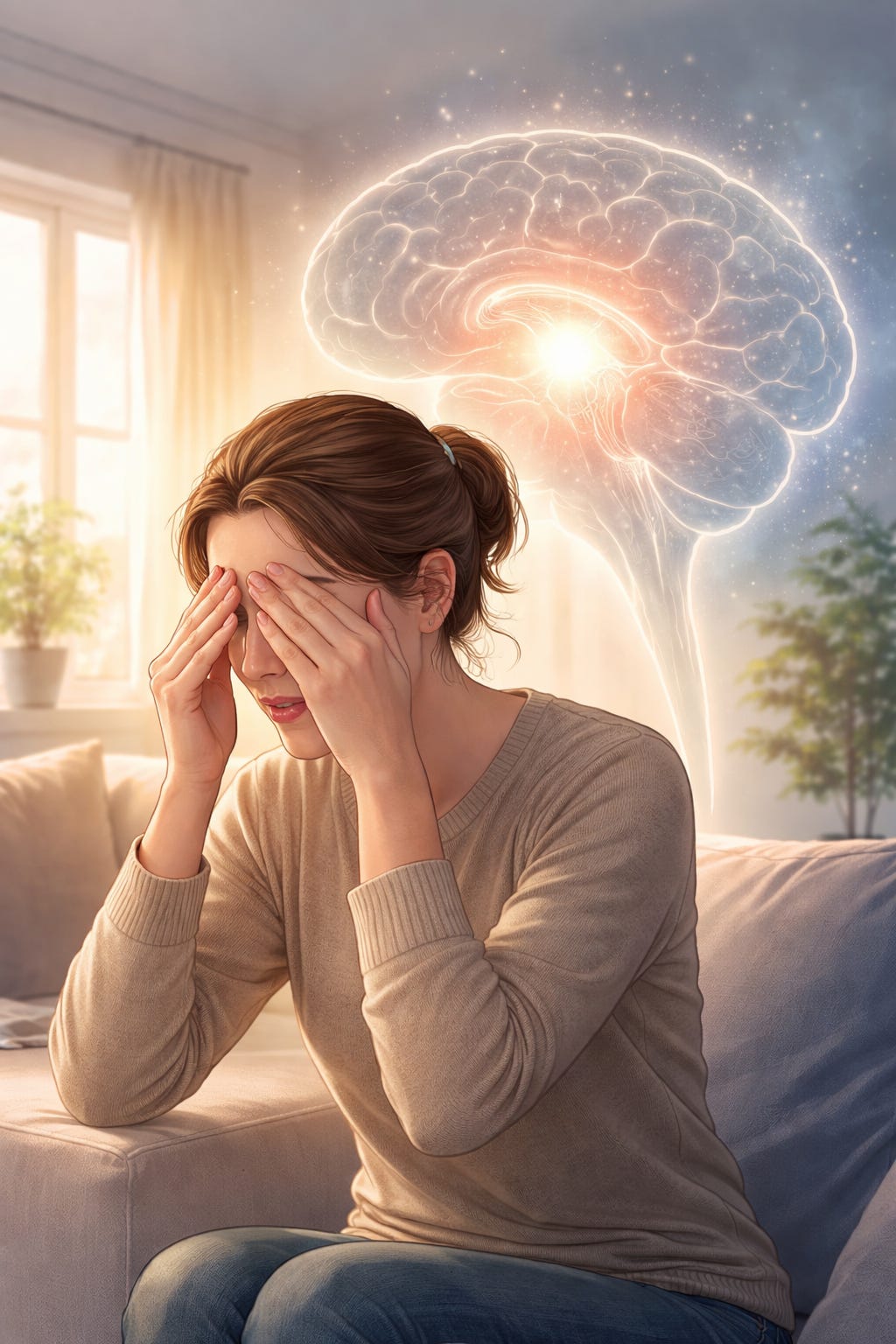
By Dr. David Traster, DC, MS, DACNB
Co-owner, The Neurologic Wellness Institute
Boca Raton • Chicago • Waukesha • Wood Dale
Most people think photophobia means “sensitive eyes.”
Too much brightness. Too much screen time. A problem with the pupils, the cornea, or the retina.
But for many patients, none of that fits.
Their eye exams are normal. Their vision is sharp. Their retina is intact. And yet light feels aggressive—sometimes painful, sometimes nauseating, sometimes destabilizing in a way that’s hard to put into words.
That contradiction is the clue.
Photophobia is not simply light sensitivity of the eyes. It is a brain-mediated sensory–pain integration disorder, where light input activates pain and threat circuits that were never meant to fire in response to illumination at all.
Across migraine, concussion, traumatic brain injury, dry eye syndromes, meningitis, and autonomic disorders, the same pattern appears:
the visual system itself is often intact—but its signals are being misinterpreted by the brain.
This is not an eye problem.
It is a problem of how the brain assigns meaning, salience, and danger to light.
Photophobia Is Not an Eye Disease
One of the most consistent findings across decades of research is also one of the most surprising to patients:
People with severe photophobia often have completely normal ophthalmologic exams.
No corneal damage.
No retinal injury.
No loss of visual acuity.
And yet they may need dark rooms, tinted lenses, or sunglasses indoors just to function.
This tells us something critical:
photophobia is not driven by damage to image-forming vision. It is driven by how sensory input is processed once it enters the brain.
In other words, the problem isn’t that light is entering the eye.
The problem is what the brain does with it afterward.
The Light Sensors That Don’t Create Vision
To understand photophobia, we need to talk about a set of retinal cells most people have never heard of.
Not rods.
Not cones.
These are intrinsically photosensitive retinal ganglion cells, often shortened to ipRGCs.
They contain a pigment called melanopsin, and they behave very differently from the cells that allow you to read, recognize faces, or see color.
These cells don’t care about detail.
They care about intensity.
They respond most strongly to blue-green wavelengths.
They fire slowly and persistently.
And instead of sending their signals to the visual cortex to create images, they project to deeper brain regions involved in regulation, arousal, and survival.
Their main targets include:
• The thalamus, where sensory input is filtered and weighted
• The hypothalamus, which regulates circadian rhythms and autonomic balance
• Brainstem nuclei involved in alertness, discomfort, and threat detection
This explains several things that patients often notice long before they understand why:
• Blue light feels especially unbearable
• Certain tinted lenses reduce symptoms
• Light can cause distress even when vision itself is absent
Photophobia is not about seeing too much.
It’s about light activating circuits that were never meant to feel painful.
Where Light Becomes Pain
The core mechanism behind photophobia lies at a junction deep in the brain.
In the thalamus, light signals from the retina converge with signals from the trigeminal nerve—the main sensory nerve of the face, eyes, and head.
This is where vision and pain intersect.
Under normal circumstances, light and pain are processed separately. But in photophobia, these pathways become abnormally coupled.
Light signals arrive at thalamic neurons that also receive nociceptive input from the trigeminal system. Instead of remaining neutral, light amplifies pain signaling, even in the absence of tissue injury.
This explains why:
• Headaches worsen in bright environments
• Facial pressure and eye ache accompany light exposure
• Patients describe light as “piercing,” “pressurizing,” or “overwhelming” rather than simply bright
Light isn’t damaging tissue.
It’s turning up the gain on pain circuits.
When the Brain Turns the Volume Too High
Another consistent finding across experimental studies is that the retina itself often functions normally.
The amplification happens centrally.
In particular, the posterior thalamus shows signs of exaggerated responsiveness—what neuroscientists call sensory gain dysregulation.
In these states, the brain assigns excessive salience to incoming light. It flags illumination as biologically urgent, threatening, or destabilizing.
This places photophobia squarely within the family of central sensitization disorders, alongside migraine, chronic pain syndromes, and persistent dizziness.
The issue is not detection.
It’s interpretation.
Why Color Matters
Many patients discover something curious on their own:
not all light feels the same.
Certain wavelengths—especially blue and red—tend to provoke symptoms more intensely. Others, particularly green light, may be tolerated better or even feel calming.
This isn’t subjective preference. It reflects distinct retinal and thalamic channels.
Cone-driven pathways interact differently with pain circuits depending on wavelength. Photophobia is not a uniform aversion to brightness—it is a specific channel dysfunction within the visual system.
That specificity is important, because it tells us this condition is structured, not random.
Inflammation, CGRP, and Shared Pathways
Across migraine, post-concussion syndromes, and even dry eye conditions, the same biochemical player keeps appearing: CGRP.
This neuropeptide increases the sensitivity of trigeminal neurons and thalamic pain circuits. When CGRP levels rise, light-induced discomfort rises with it.
This helps explain why photophobia appears across such different diagnoses—and why treatments aimed at reducing trigeminal sensitization can help seemingly unrelated conditions.
The disorder isn’t in the eyes.
It’s in a shared sensory–pain network.
The Cortex Is Involved—but It’s Not the Source
The visual cortex does matter. Hyperexcitability there can worsen symptoms and prolong discomfort.
But photophobia can occur:
• Without visual aura
• Without cortical lesions
• In primarily subcortical disorders
The cortex modulates the experience—it doesn’t create it.
The origin lies deeper, where light, pain, and regulation converge.
Light, Autonomic Tone, and the Emotional Brain
Finally, photophobia cannot be separated from the autonomic and emotional systems.
Light activates:
• Hypothalamic stress circuits
• Limbic regions involved in threat and avoidance
• Brainstem arousal centers
This is why photophobia often comes with nausea, anxiety, fatigue, and cognitive overload.
It’s why symptoms worsen with poor sleep, stress, or illness.
And it’s why photophobia often precedes migraines or flares of autonomic dysfunction.
The brain is not just reacting to light.
It is preparing for danger that isn’t actually there.
The Bigger Picture
Photophobia is best understood as a disorder of abnormal light–pain coupling.
It is driven by:
• Melanopsin-based retinal signaling
• Thalamic sensory gain dysregulation
• Trigeminal nociceptive convergence
• Neuroinflammatory sensitization
• Autonomic and limbic engagement
It is not explained by:
• Eye damage alone
• Visual acuity loss
• Simple brightness intolerance
And once we understand that, something important shifts.
Photophobia stops being mysterious.
It stops being dismissed.
And it becomes treatable—not by chasing the eyes, but by addressing the brain systems that decide what light means.
In that sense, photophobia belongs in the same conversation as migraine, persistent dizziness, post-concussion syndromes, and other disorders where the brain’s predictions—not the incoming signals—are what need recalibration.
Light hasn’t changed.
The brain’s relationship to it has.
How the Brain Can Be Calmed Without Blocking the Light
When patients ask whether there are ways to treat photophobia without medication or surgery, the question often carries a deeper concern.
They don’t want to numb themselves.
They don’t want to suppress symptoms blindly.
They want to understand what’s happening—and whether the brain can be retrained rather than overridden.
The research suggests the answer is yes.
Not by avoiding light forever.
Not by forcing exposure indiscriminately.
But by modulating the circuits that decide when light becomes a threat.
Photophobia, as we’ve explored, is not simply a problem of brightness. It’s a disorder of abnormal light–pain coupling, driven by specific neural networks: retinal signaling pathways, the thalamus, trigeminal pain circuits, and the autonomic and limbic systems that determine safety versus danger.
That understanding opens the door to therapies that are noninvasive, non-pharmaceutical, and targeted—interventions designed to recalibrate signaling rather than silence it.
Using Light to Heal Light Sensitivity
This may sound counterintuitive at first.
If light causes pain, why would light be used as therapy?
But not all wavelengths are processed the same way by the brain.
Narrow-Band Green Light Exposure
One of the most intriguing approaches studied in migraine-related photophobia involves controlled exposure to a narrow band of green light. Unlike blue or red wavelengths, green light appears to be processed in a way that is less aversive to pain-sensitive thalamic circuits.
In clinical observations and real-world data, some patients experience:
• Reduced photophobia during migraine attacks
• Improved tolerance to ambient lighting
• Secondary benefits in sleep quality and anxiety
The mechanism matters here. This is not about “toughening up” to light. It’s about presenting a wavelength that does not excessively activate trigeminal–thalamic convergence.
This approach reframes light not as the enemy—but as a signal that can be tuned.
Filtering the Signal Before It Reaches the Brain
Another strategy works one step earlier in the system.
Precision Tinted Lenses (FL-41 and Related Filters)
Certain lenses selectively reduce wavelengths most likely to provoke discomfort—especially those that strongly activate melanopsin-containing retinal cells.
In controlled and clinical populations:
• Light sensitivity improves compared to neutral gray lenses
• Blink frequency and discomfort decrease
• Daily function improves in people with chronic ocular pain or dry eye–associated photophobia
What’s happening here is subtle but powerful.
By altering spectral input, these lenses change the message sent to the brain, reducing the likelihood that light will be interpreted as a nociceptive signal. It’s peripheral input modification that behaves like neuromodulation.
Not avoidance.
Not suppression.
Just cleaner signaling.
Modulating the Brainstem and Thalamus From the Inside
Some approaches bypass the retina entirely and work directly on the circuits that regulate sensory gain.
Noninvasive Vagus Nerve Stimulation
The vagus nerve is a major highway connecting the brainstem to autonomic, limbic, and pain-regulating networks. Noninvasive stimulation—either at the neck or the ear—has been studied extensively in migraine, a condition where photophobia is a defining symptom.
When migraine burden decreases, photophobia often follows.
Why? Because vagal afferents influence:
• Brainstem arousal systems
• Thalamic sensory gating
• Autonomic balance
For patients whose light sensitivity flares with stress, poor sleep, or autonomic instability, vagus nerve stimulation acts less like a painkiller and more like a regulatory reset.
Turning Down Visual Gain at the Cortical Level
Another approach works from above.
Transcranial Direct Current Stimulation
Low-intensity electrical stimulation applied over the occipital region or related networks has been studied in migraine prevention. While photophobia is rarely isolated as the sole outcome, it frequently improves as attack frequency and sensory hypersensitivity decline.
This makes sense.
If the visual cortex and its thalamocortical loops are running “too hot,” reducing excitability can:
• Lower visual amplification
• Improve tolerance to light
• Reduce sensory overload
This is not about forcing inhibition. It’s about normalizing gain.
Targeting the Visual–Pain Interface Directly
Some experimental approaches sit right at the junction where vision and pain intersect.
Occipital-region stimulation strategies—whether via transcutaneous nerve stimulation or static magnetic fields—have been explored for their effects on light sensitivity. These methods are still emerging, but they reflect a consistent theme in the research: photophobia improves when the visual–pain interface is calmed, not when vision itself is blocked.
Nutrition as Neuromodulation
Not all neuromodulation requires a device.
Some of the most consistent evidence for non-drug support comes from nutrients that stabilize neuronal metabolism and excitability—particularly in migraine-related photophobia.
Magnesium, Riboflavin, and CoQ10
This combination targets mitochondrial efficiency and neuronal firing thresholds. In controlled trials and integrative reviews, these nutrients reduce migraine frequency and severity over time.
When migraine biology quiets, photophobia often quiets with it.
These nutrients don’t numb the system.
They support its energy economy.
Riboflavin Alone
At higher doses, riboflavin has been shown to reduce migraine burden over months—again, indirectly improving photophobia by stabilizing central sensory networks.
CoQ10
CoQ10 supports mitochondrial function and antioxidant capacity. For some patients, especially those with fatigue and sensory overload, this translates into improved tolerance across systems—including light.
When the Eye Surface Is Part of the Story
Not all photophobia is centrally driven.
For patients with burning, foreign-body sensation, or eye ache, ocular surface inflammation can act as a persistent trigeminal irritant.
Omega-3 Fatty Acids
In dry eye populations, omega-3 supplementation improves both symptoms and clinical signs. By calming peripheral inflammation, trigeminal drive decreases—and light becomes less provocative.
In these cases, addressing the eye surface reduces the noise entering the system.
Choosing the Right Strategy
Photophobia is not one condition. It’s a pattern.
When it presents with:
• Episodic headaches
• Nausea
• Sound sensitivity
• Predictable triggers
Migraine-oriented neuromodulation and nutritional strategies tend to be most effective.
When it presents with:
• Eye burning
• Foreign-body sensation
• Fluctuating discomfort
Peripheral filtering and ocular-surface support matter more.
After concussion or brain injury, the evidence base is thinner—but the circuitry is the same. Clinicians often borrow from migraine research carefully, tracking symptoms and adjusting based on response.
And Then There’s the Trigeminal Nerve
Which brings us to one of the most compelling tools in this entire landscape.
Trigeminal Nerve Stimulation
Photophobia lives at the intersection of retinal input, thalamic gain, and trigeminal nociception.
Trigeminal nerve stimulation targets that exact intersection.
Using surface electrodes placed over the forehead, noninvasive stimulation activates afferent fibers of the ophthalmic branch of the trigeminal nerve. These fibers project directly into the brainstem and posterior thalamus—where light and pain signals converge.
This is not muscle stimulation.
It is sensory neuromodulation.
Research shows that repeated stimulation:
• Reduces trigeminal hyperexcitability
• Lowers thalamic sensory gain
• Modulates CGRP-related pathways
• Influences limbic and autonomic centers
As these circuits quiet, light stops amplifying pain.
Clinical trials in migraine—where photophobia is a core feature—show consistent improvements alongside reduced headache burden. In post-concussion and central sensitization syndromes, early evidence and clinical reports suggest similar benefits.
Trigeminal nerve stimulation doesn’t block light.
It uncouples light from pain.
The Bigger Message
None of these approaches are about suppression.
They are about restoring discrimination—helping the brain relearn that light is information, not danger.
Photophobia improves not when we hide from light, but when we help the nervous system recalibrate the meaning it assigns to sensory input.
The goal isn’t darkness.
The goal is clarity.
And increasingly, research shows that clarity can be achieved without drugs or surgery—by working with the brain, not against it.
Conclusion: When Light Stops Being a Threat
Photophobia is not a failure of the eyes.
It is a miscommunication between light and the brain.
For years, patients have been told to dim screens, wear sunglasses, avoid triggers, and wait for it to pass. Some of that advice helps in the short term—but it never answers the deeper question patients are really asking:
Why does light feel dangerous to my nervous system?
The research now gives us an answer.
Light becomes painful not because it is too strong, but because the brain has learned—often after injury, inflammation, migraine, or prolonged stress—to interpret it as a threat. Circuits meant to regulate safety, arousal, and pain begin to fire in response to illumination. The volume knob gets turned up. The signal loses nuance.
And when that happens, the solution isn’t to live in darkness.
The solution is to teach the brain to discriminate again.
The approaches explored in this article—spectral light modulation, precision filters, neuromodulation of the vagus and trigeminal systems, cortical gain regulation, and targeted nutritional support—share a common philosophy. They don’t suppress symptoms. They don’t override sensation. They work by recalibrating the networks that decide what light means.
That distinction matters.
Because photophobia improves not when we eliminate light, but when the nervous system relearns that light is information—not danger.
This reframes photophobia from a frustrating, mysterious symptom into something far more hopeful: a plastic, reversible pattern of brain processing.
Light hasn’t changed.
What has changed is the brain’s relationship to it.
And relationships—especially those built on prediction, safety, and meaning—can be repaired.
References
Digre, K. B., & Brennan, K. C. (2012). Shedding light on photophobia. Journal of Neuro-Ophthalmology, 32(1), 68–81.
Noseda, R., & Burstein, R. (2011). Advances in understanding the mechanisms of migraine-type photophobia. Current Opinion in Neurology, 24(3), 197–202.
Noseda, R., Kainz, V., Jakubowski, M., Gooley, J. J., Saper, C. B., Digre, K., & Burstein, R. (2010). A neural mechanism for exacerbation of headache by light. Nature Neuroscience, 13(2), 239–245.
Noseda, R., Bernstein, C. A., Nir, R. R., Lee, A. J., Fulton, A. B., Bertisch, S. M., Hovaguimian, A., Cestari, D. M., Saavedra-Walker, R., Borsook, D., Doran, B. L., & Burstein, R. (2016). Migraine photophobia originating in cone-driven retinal pathways. Brain, 139(7), 1971–1986.
Burstein, R., Noseda, R., & Fulton, A. B. (2019). Neurobiology of photophobia. Journal of Neuro-Ophthalmology, 39(1), 94–102.
Wu, Y., Noseda, R., & Burstein, R. (2017). Photophobia in neurologic disorders. Translational Neurodegeneration, 6, 26.
Blackburn, M. K., Lamb, R. D., Digre, K. B., Smith, A. G., Warner, J. E. A., McManis, S. E., & Katz, B. J. (2009). FL-41 tint improves blink frequency, light sensitivity, and functional limitations in patients with benign essential blepharospasm. Ophthalmology, 116(5), 997–1001.
Martin, P. R., Reece, J., Callan, D., MacLeod, C., Kaur, A., Gregg, K., Goadsby, P. J., & Fanning, K. M. (2021). Evaluation of green light exposure on headache frequency and quality of life in migraine patients: A preliminary one-way cross-over clinical trial. Cephalalgia, 41(13), 1357–1369.
Tassorelli, C., Grazzi, L., de Tommaso, M., Pierangeli, G., Martelletti, P., Rainero, I., Dorlas, S., Geppetti, P., Ambrosini, A., Sarchielli, P., & on behalf of the PRESTO Study Group. (2018). Noninvasive vagus nerve stimulation as acute therapy for migraine: The randomized PRESTO study. Neurology, 91(4), e364–e373.
Schoenen, J., Vandersmissen, B., Jeangette, S., Herroelen, L., Vandenheede, M., Gérard, P., & Magis, D. (2013). Migraine prevention with a supraorbital transcutaneous stimulator: A randomized controlled trial. Neurology, 80(8), 697–704.
Interestingly, recent studies suggest the gut–brain axis may subtly influence photophobia: microbial metabolites like short-chain fatty acids could modulate trigeminal and thalamic excitability. This hints that diet or probiotics might indirectly reduce light-induced pain. I find this fascinating—it reframes photophobia not only as a brain disorder but as a systemic network issue, opening integrative therapeutic possibilities.